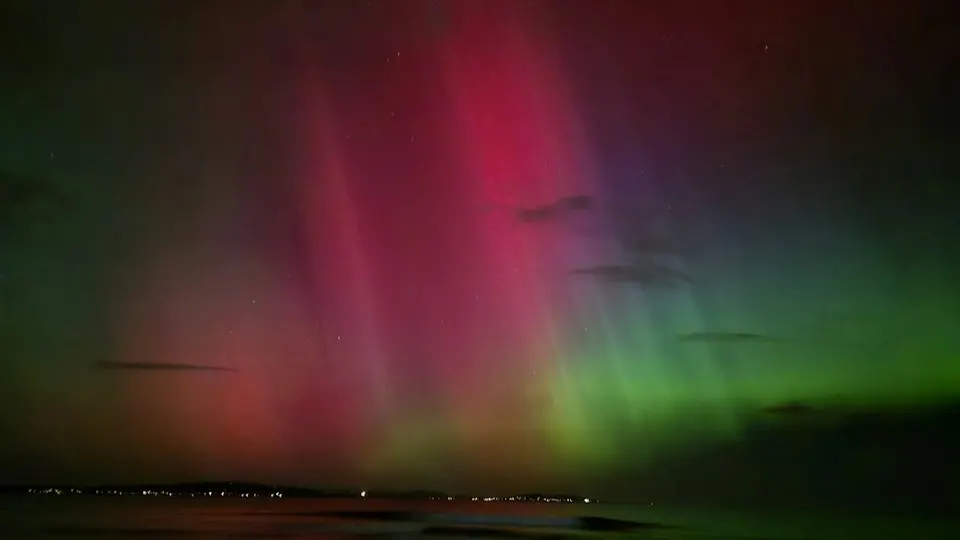
To photograph the northern lights you need a tripod, manual focus at infinity and an exposure of a few to a dozen or so seconds. On a phone, switch on night mode or set a manual exposure of 3–10 seconds. On a camera, start at ISO 1600, the widest aperture and 10 seconds.
Why a photo shows more than your eye
In dim light the eye uses rods, which see only shades of grey. The cones that detect colour need brighter light. An aurora is usually too faint for them, so to the naked eye it looks like a grey or whitish glow. A sensor gathers light for several seconds and records the green and pink your eye misses. That is why at Kp 5 it is worth taking photos even when you see nothing.
What to bring
- A tripod. This matters most. Without it a multi-second exposure will blur. On a beach you can prop a phone against a bag or a stone, but a tripod is better.
- A remote or a 2-second self-timer. Touching the screen during the exposure shakes the image.
- A red torch. White light ruins your night vision and spills into other people's frames.
- A spare battery. Cold drains batteries fast. At -10°C lithium batteries lose 30–50 per cent of their capacity. Keep the spare in a pocket against your body.
Camera: starting settings
- Manual mode (M). You set everything yourself.
- Widest aperture. The lowest f-number your lens has, such as f/1.8 or f/2.8. Stopping down gains nothing, because the aurora is far away.
- ISO 1600–3200. With a slower lens, f/4–5.6, you can go up to ISO 6400. Pick the lowest value that gives a bright enough picture.
- Exposure time: start at 10 seconds. Fast, rippling curtains need 4–6 seconds, because longer blurs them. Faint, slow arcs will take 15–20 seconds.
- The 500 rule. The maximum time is 500 divided by the focal length. At 24 mm that is about 20 seconds, after which stars start to trail. On a sensor smaller than full frame, multiply the focal length by the crop factor first.
- White balance about 3500–4000 K. If you shoot RAW you can change it later.
- RAW format. It gives you room to reduce noise and correct colours.
Focus: manual, at infinity
Autofocus fails at night, so set focus by hand. You have two methods:
- In daylight. Autofocus on a distant object, switch to manual and tape the focus ring. Check the infinity mark on the lens in daylight, because it is often inaccurate.
- At night. In live view, magnify a bright star or a distant light and turn the ring until the point is smallest. Check again after an hour, because a fall in temperature can shift the focus.
Phone: how to set it up
- Put the phone on a tripod. Night mode extends the exposure by itself, but only if the phone stays still.
- Use night mode or manual mode. In manual mode set 3–10 seconds and ISO around 1600, usually no more than 3200. In a strong aurora 2–5 seconds is enough, in a faint one 15 seconds or more if the phone allows it.
- Use the main lens. It is brighter than the ultra-wide.
- Focus at infinity. If the phone has manual focus, set it to the infinity symbol, or tap a bright star or a distant light.
- Use a 2–3 second self-timer or a Bluetooth remote. Do not touch the screen during the shot.
- Do not shoot through glass. The glass reflects the light from inside.
A phone loses detail compared with a camera, because its processing smooths the image. For a faint aurora a camera does better.
Framing and mistakes
- Wide angle. The aurora fills a large part of the sky, and it helps to have a foreground in front of it: a cliff, trees, a dune.
- North in the frame. Use the compass on your phone and point the camera north.
- Do not oversaturate. Heavy saturation gives an unrealistic picture.
- Turn the flash off. It will not light anything 100 km away.
- Take a test shot. Zoom into the preview on the screen to check brightness and focus.
If you do not know where to put the tripod, see the list of places in the guide on where to see the northern lights in Poland. The current score is in the aurora forecast.
Email alert
Do not miss the next window
The best windows last a few hours: after a storm, after rain, on a clear night with an active Sun. Sign up and we will email you when the index at your spots goes above 60.