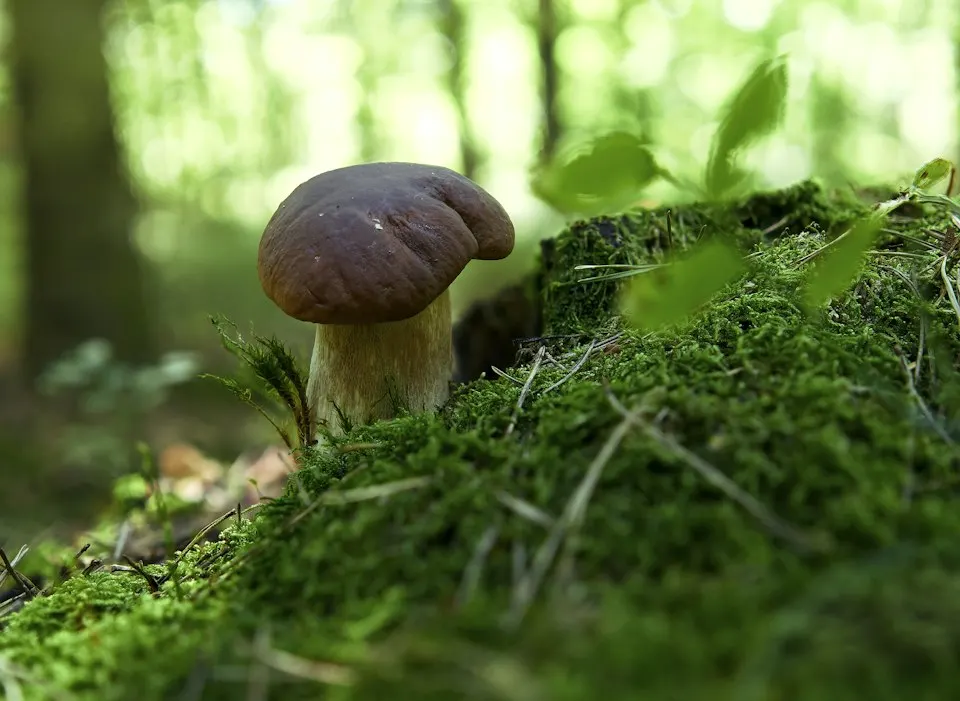
Mushrooms do not pop up on the day it rains. Between the rain and the first fruiting bodies there is usually a gap of one to ten or more days. The gap depends on the species, the temperature and how dry the soil was before.
How many days after rain
The fungus lives in the litter and soil as a network of threads (mycelium). After rain it has to soak up water first, and only then does it build mushrooms. The firmer and larger the mushroom, the longer it takes. Rough delays after a proper rain:
- Birch boletes (koźlarze): 1 to 2 days.
- Slippery jacks (maślaki): 1 to 3 days.
- Chanterelles (kurki): 2 to 5 days.
- Parasol mushrooms (kanie): about 4 days.
- Bay boletes (podgrzybki): 4 to 6 days.
- Penny buns / cep (prawdziwki): 6 to 10 days, often a week or more.
These are rules of thumb, not promises. In cool weather the wait gets longer, and in a dry forest it can be longer than the list suggests.
Which rain counts
Several calm days of rain do more than one short downpour. Water from a downpour runs off the surface and never reaches the mycelium. A light passing shower only wets the top layer of litter.
After a long dry spell the soil soaks up water first, and only then does the mycelium get any. That is why the first rain after a drought often is not enough. Sometimes only the second or third spell of rain starts a flush.
The ground matters too. Sandy pine forest takes in water fast but also dries fast. Forest on clay soils with a thick litter layer holds moisture longer, so the flush there usually lasts longer.
Temperature
As a rough guide, mushrooms form most readily when the soil is about 8 to 18 °C and the daytime air is about 15 to 22 °C. The range differs between species, so treat it as an approximation.
- Heat: a few hot days with dry air dry out the litter and slow growth, even after earlier rain.
- Frost: one cold night does not kill the mycelium, but it damages mushrooms that have already come up. After several nights of frost the season usually ends.
Rain is local
Summer storms fall in patches. Rain in the next county does not mean it rained in the forest you are driving to. That is why the forecast calculates rainfall separately for each region. Check the score for the forest you choose, not for the whole country.
How our forecast calculates it
The mushroom forecast does not show how many mushrooms are in the forest. It shows whether conditions favour them. The index looks at four things:
- Rainfall over the last 7 to 21 days. That window matches the time the mycelium needs after getting water.
- Soil moisture, meaning whether the water has actually soaked in.
- Temperature over the last few days.
- Frost, which lowers the score.
The index cannot see whether someone has already picked the forest clean. It also does not know whether the forest is closed. For the rules, read where you can pick mushrooms in Poland.
How to use this
- Check how much and when it rained over the last three weeks where you are going.
- Check the night forecast. Frost in the next few days lowers your chances.
- For slippery jacks and chanterelles, go a few days after rain. For bay boletes and cep, give the forest a week to ten days.
- Match the forest to the weather. After a short rain, go where the soil holds water. After a long rain, pine forest works well.
- Open the region pages and check the local bans.
Email alert
Do not miss the next window
The best windows last a few hours: after a storm, after rain, on a clear night with an active Sun. Sign up and we will email you when the index at your spots goes above 60.