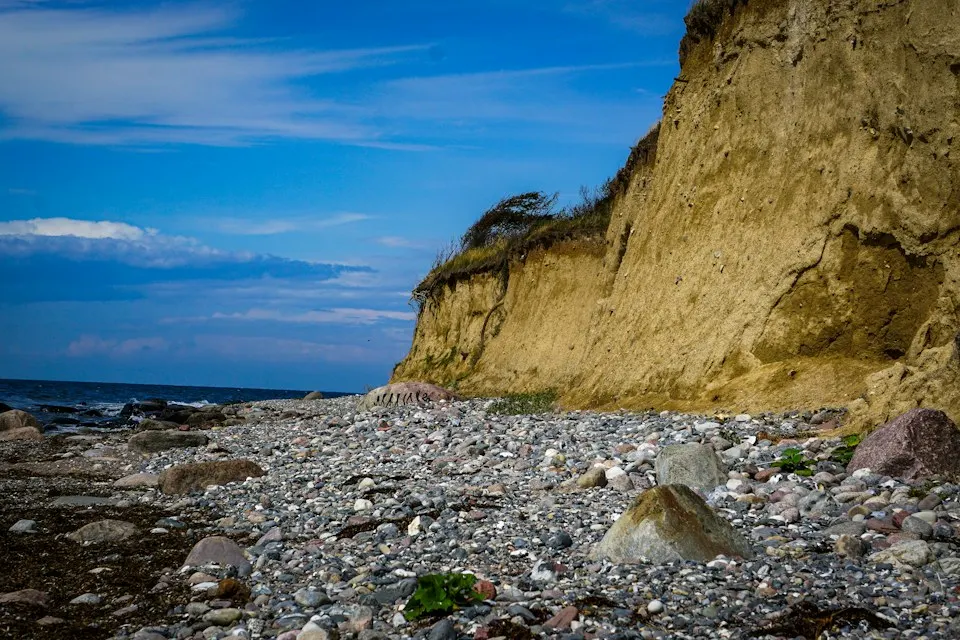
Most fossils lie on the beach a few hours after the peak of a storm that hit the cliff. The second good window is a thaw after a freezing winter, when the slope slumps. The same window is also the most dangerous.
Why storms
Waves cut at the foot of the cliff. Clay and sand wash out of the till, and the heavy stones stay behind. A gravel band made only of stones forms. The fossils are in that band because they are heavy or sit inside flint. After a storm the sand has gone and the stones lie on top.
When the waves drop and the water falls, you get a clean, fresh surface. If you wait too long, calm seas bring sand back and cover the gravel. So go a few hours after the peak, not the next day.
Why a thaw
A cliff retreats from the land side as well as from the sea. Rain, frost and wind wear it down, and groundwater seeps out of the slope and triggers slumps. At Jastrzębia Góra the slides start in a clay layer that the water runs along. At the Redłowo cliff the biggest changes happen after winter storms, from November to March.
In a thaw the saturated slope slides onto the beach together with its stones. This is fresh material that nothing has touched yet. The same mechanism makes the foot of the cliff most dangerous at that time.
How to spot a fresh slump
- A pale, bare face. No grass and no roots, the colour of clay.
- A wet, uneven slope. Seepage and slide marks.
- A pile of clay and stones at the foot. With pieces of trees or turf.
- Cracks along the edge. A sign that the next piece is ready to go.
Look at a slump from a distance. Collect stones at its foot only if you do not have to go under the face.
How we calculate the index
We calculate the fossil index the same way as the amber index. We take the wave energy hitting the cliff at that spot. We work it out from the wave height (squared), add a small share for onshore wind, and add up the last 48 hours, with older hours counting less. Each beach has the direction it faces stored in degrees. A wave from another side hardly counts, so the same storm gives different results. The second part is the time since the storm peak. The highest score comes when the waves are already dropping. About 36 hours after the peak the score starts to fall. Finally we apply the richness of the spot, meaning how many fossils usually lie there.
The index does not see a thaw, rain, or whether someone walked the beach before you. You judge those on site.
A high index means two things: more fossils and a higher risk of slumps. Check the fossil forecast and read the rules in the guide rules and cliff safety.
Season and time of day
Storms are most frequent from late autumn to early spring. In summer there are fewer washed-up stones, and the beaches are full of people who pick them up first. Go at dawn. The sun is low and picks out the shapes, and the beach is empty.
Which cliff for which wind
The West Pomeranian cliffs at Rewal and Trzęsacz face north and north-west, so they react to storms from those directions. Orłowo faces east and takes storms from the east and north-east. A storm from the north-west misses that beach.
Email alert
Do not miss the next window
The best windows last a few hours: after a storm, after rain, on a clear night with an active Sun. Sign up and we will email you when the index at your spots goes above 60.