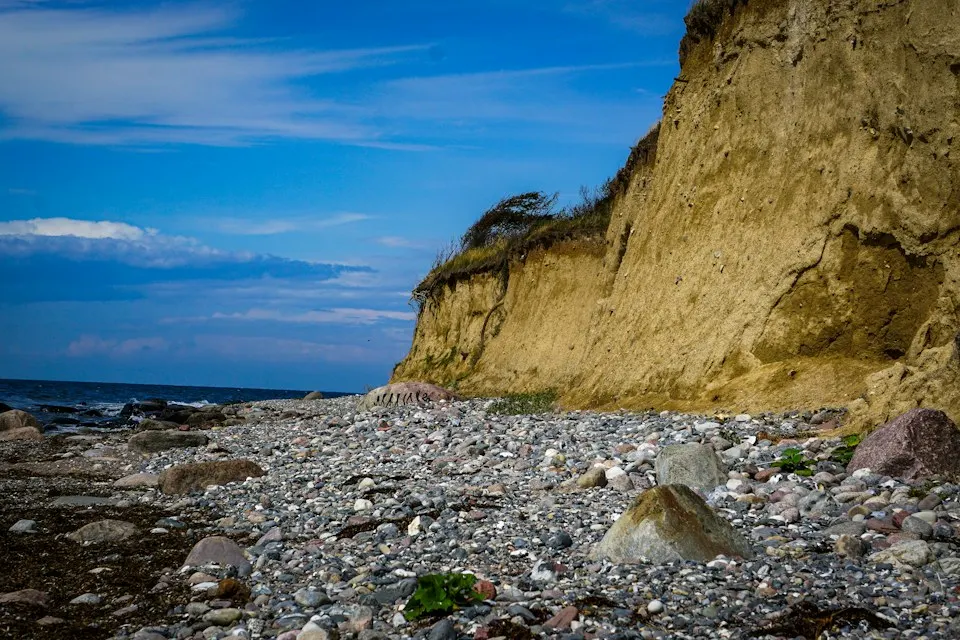
You may collect loose fossils from a beach for your own use outside protected areas. In national parks and nature reserves you may take nothing. A cliff is a bigger danger than a fine, so the safety rules matter more than the law. This is not legal advice. Check the current position before you travel.
Where the ban applies
The Nature Conservation Act bans, in national parks and nature reserves, the extraction of rocks, fossils, minerals and amber. It also bans damaging natural objects and moving outside the marked paths. Similar bans apply to natural monuments.
On our coast that means:
- Wolin National Park. The Gosań and Kawcza Góra cliffs lie in it. You take nothing there.
- Słowiński National Park. The same ban.
- Kępa Redłowska reserve in Gdynia. Created in 1938, it includes the Orłowo cliff. Do not assume the beach below lies outside the reserve. Check the boundary.
- The reserves Cape Rozewie and the Rudnik gorge. They lie by the cliffs at Jastrzębia Góra and Chłapowo.
Natura 2000 areas and landscape parks, such as the Coastal Landscape Park, may have their own limits. You can check the boundaries in the GDOŚ geoportal or with the Regional Directorate for Environmental Protection (RDOŚ): in Szczecin for West and Central Pomerania, in Gdańsk for Gdańsk Pomerania and the Tricity.
What is allowed outside the ban
Outside protected areas you may pick up loose fossils from the surface of the beach. Do it by hand, in small amounts and for your own use. Geotourism guides state that collecting for a private collection is allowed in Poland, and not allowed in reserves, national parks and natural monuments. Remember also that the stretch Pobierowo, Trzęsacz, Rewal and Śliwin was proposed for protection as natural monuments of inanimate nature.
What not to do
- Do not dig into the cliff. It interferes with the shore, and the face slumps. The rules for collecting amber ban deep pits and damage to dunes. We know of no separate rule for fossils, so take the same care.
- Do not use hammers or crowbars on the face.
- Do not enter areas marked as hazardous. In the technical belt of the shore you may not, without authorisation, stay in fenced or marked areas at risk of erosion.
- Do not leave litter or light fires. Both are banned in the technical belt.
Report marine reptile bones and other big finds to a natural history museum or to the Polish Geological Institute, Marine Geology Branch in Gdańsk. A specimen like that has scientific value.
Safety under a cliff
Most Polish cliffs are 12 to 30 m high, and the slope averages about 41 degrees. The sea takes up to 0.5 m of cliff a year on average, and at Jastrzębia Góra it took 0.94 m a year between 1977 and 1990. Slumps happen after storms, during a thaw and after rain. The rules are simple.
- Do not stand under the cliff face. Our rule: keep a distance at least equal to the height of the cliff.
- Do not go under overhangs or undercut slopes.
- Do not sit under the cliff to rest or lay out your gear there.
- Do not climb the cliff, and do not walk to its edge from above.
- Check how you will get back. On a narrow beach a storm surge will cut off your route.
- Go with someone and carry a charged phone. In an emergency call 112.
Watch out for what people have left behind. In 2009 a wave uncovered concrete posts with bars sticking out at Rewal. At Jastrzębia Góra the gabion defences have been described as in a state of failure. Do not climb on them.
When to stay at home
While a storm is blowing and waves are still hitting the cliff, stay on top. Go onto the beach only after a few hours, when the sea drops. We explain how to choose a date in the guide when to look for fossils, and give an overview of places in where to find fossils. The current conditions are on the fossil forecast.
Email alert
Do not miss the next window
The best windows last a few hours: after a storm, after rain, on a clear night with an active Sun. Sign up and we will email you when the index at your spots goes above 60.