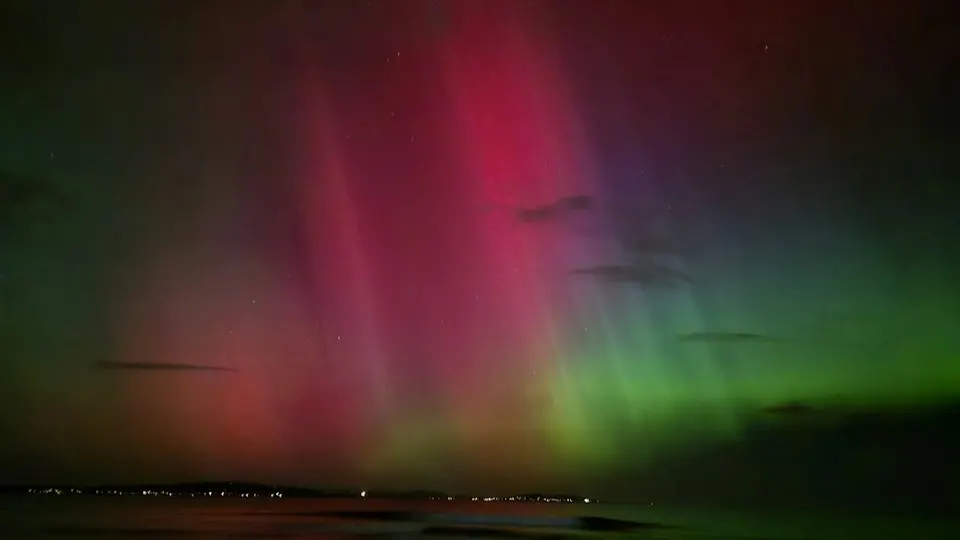
The Sun goes through an activity cycle of about 11 years. The maximum of Solar Cycle 25 came in October 2024, which is why the northern lights have been visible over Poland more often than a few years earlier. Activity does not switch off after the peak, so the chances remain, although they will shrink over time.
The 11-year cycle and sunspots
The Sun has periods with few spots on its surface and periods with very many. Sunspots are areas of strong magnetic field, and flares and coronal mass ejections come from them. When such an ejection hits Earth, it causes a geomagnetic storm. The more spots, the more ejections.
The number of spots is described by a smoothed index. The Belgian centre SIDC reported that the maximum of Cycle 25 reached a value of 161 in October 2024. This is confirmed with a delay of about six months, because the index is smoothed.
The peak was in 2024
On 15 October 2024 NASA and NOAA announced that the Sun had reached the maximum period of Cycle 25. Forecasts made a few years earlier expected a lower peak, so the level of activity surprised many people. In May 2024 the aurora was photographed over Poland, and on 19 January 2026 it was visible across almost the whole country, from the coast to the Tatras.
After the peak, it does not all end
Sunspots are most numerous at the maximum, but storms do not vanish at once. In the declining phase of the cycle, streams of fast solar wind from coronal holes come to the fore. Research shows that the highest solar wind speeds at Earth are seen in the declining phase. That wind drives storms mainly at high latitudes, so over Poland they are usually weaker than those after big mass ejections.
In practice, you can expect strong storms in the coming years, but they will be rarer and harder to predict. So it pays to follow the forecasts and go out when a window opens.
Equinoxes: why September and March
Storms are more frequent around the equinoxes, in March and April and in September and October. The Russell-McPherron effect explains this. The direction of the magnetic field in the solar wind changes through the year together with the tilt of Earth's axis. Around the equinoxes the north-south component of that field is more often opposite to Earth's field. Then the two fields link up, the solar wind enters the magnetosphere more easily and the storm strengthens.
The effect is not absolute and does not explain everything. Strong storms happen in every month, and you can see aurora in May or January too, but statistically the equinoxes have the edge.
In northern Poland there is a second factor: the length of darkness. From May to July the nights are too bright, so September and October and March and April combine good storms with long, dark nights.
Why a camera sees more than your eye
In dim light the eye uses rods, which cannot tell colours apart, because cones need brighter light. An aurora over Poland is usually faint, so to the naked eye it looks like a grey or greenish glow. A camera gathers light for several seconds and records colours you do not notice. At Kp 5 and 6 a photo can be much brighter than what you see. In the strongest storms the aurora is so bright that the colours show without a camera. Settings are in the guide on how to photograph the northern lights.
How to make use of this
- Check the aurora forecast every few days, and on the day of a storm check live data too.
- Look for windows in September and October and in March and April, but go out at other times too when a storm is strong.
- Choose a place with an open horizon to the north. The list is in the guide on where to see the northern lights in Poland.
- Do not count on regularity. A storm depends on whether an ejection hits Earth and how its magnetic field is oriented.
The basics are in the Kp index guide, and the full list of conditions is in northern lights in Poland.
Email alert
Do not miss the next window
The best windows last a few hours: after a storm, after rain, on a clear night with an active Sun. Sign up and we will email you when the index at your spots goes above 60.