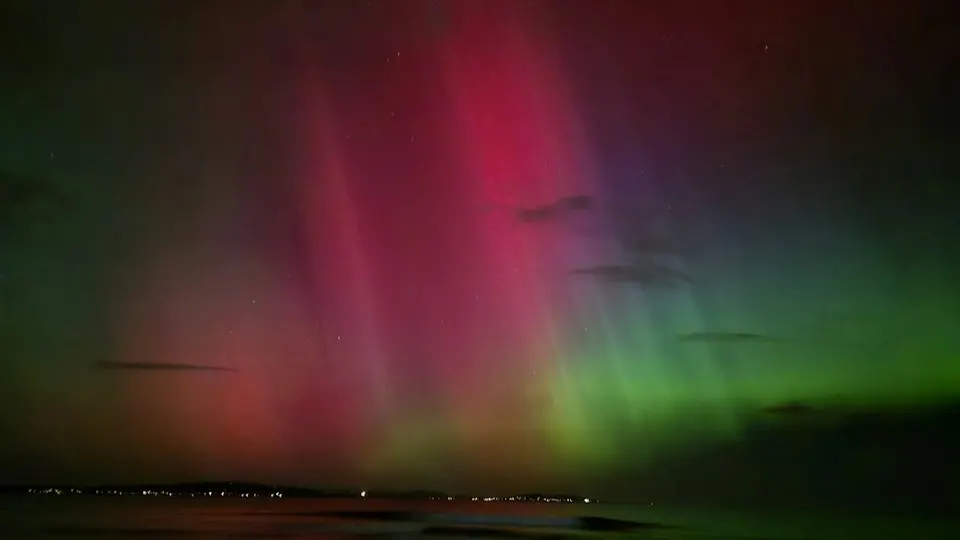
You can see the northern lights in Poland only during strong geomagnetic storms. On the coast a camera can pick them up from Kp 5, and the naked eye usually needs Kp 6 or 7, low above the northern horizon. You also need a clear, dark night.
Where the aurora comes from
The Sun throws out charged particles. When they reach Earth, its magnetic field steers them towards the poles. There they collide with atoms in the upper atmosphere, usually from about 100 km up. Oxygen glows green and red, nitrogen glows violet and pink.
On an ordinary night the aurora stays far to the north, in an oval around the magnetic pole. In a storm the oval widens southwards and reaches Poland. NOAA says a bright aurora can sometimes be seen from up to 1,000 km away.
Five conditions that must line up
- A geomagnetic storm. Look for a forecast of Kp 5 or higher. We explain the number in the Kp index guide.
- A clear sky. Clouds a few kilometres up hide an aurora that is 100 km higher. A strong storm under cloud shows nothing.
- Darkness. Get out of town, ideally where you cannot see street lamps. A full Moon brightens the sky and drowns a faint aurora, so the days around the new Moon are easier.
- An open northern horizon. Over Poland the aurora is low, often only a few to a dozen or so degrees above the horizon. Trees, hills and buildings block it.
- The right time of year. Look from late August to April. Details below.
Which Kp is enough in Poland
This is a rule of thumb based on descriptions from National Geographic Polska. It is not a guarantee.
- Kp 4–5: a faint glow low over the northern horizon, usually only in a photo, easiest from the coast.
- Kp 6: northern and central Poland. The aurora can be visible to the naked eye as a pink or red glow.
- Kp 7: the whole country, including the southern edge.
- Kp 8–9: aurora across the country, sometimes reaching overhead.
How our forecast works
For each place separately, we combine four things:
- the Kp forecast from NOAA,
- night-time cloud cover at that place,
- the phase and height of the Moon,
- latitude, because it decides which Kp you need.
On the Baltic coast a lower Kp is enough than in the Bieszczady, so the same Kp gives two different scores in two places. Cloud can drag a score to zero even in a strong storm. Open the aurora forecast and compare a few places.
Aurora in Poland tonight: how to check
A forecast Kp several days ahead is uncertain. The best signal comes 30 to 90 minutes before the aurora, because that is how long the solar wind takes to travel from the satellites ahead of Earth to us. On the night of a storm, check live data and not only yesterday's forecast.
When to go out
From May to July the nights in northern Poland are too bright. In June the Sun is only about 12° below the horizon at midnight on the Baltic coast, so the sky never gets properly dark. The season runs from late August to April.
Storms are more frequent around the equinoxes, in September and October and in March and April. We explain why in the guide to the solar cycle. A strong storm can still come in any month. On 19 January 2026, for example, the aurora appeared across the whole of Poland.
What to do on site
- Arrive before dark and check on your phone where north is. The horizon in that direction must be clear.
- Give your eyes about 20 minutes to adapt to the dark. Do not look at a bright screen, and swap your torch for a red light.
- Take photos even when you see nothing. A few seconds of exposure often shows green that your eye cannot yet tell apart. Settings are in the guide on how to photograph the northern lights.
- Wait at least an hour. A storm lasts for hours, and the aurora pulses and can brighten for ten minutes or more.
You will find a list of tested places with an open northern horizon in the guide on where to see the northern lights in Poland.
Email alert
Do not miss the next window
The best windows last a few hours: after a storm, after rain, on a clear night with an active Sun. Sign up and we will email you when the index at your spots goes above 60.