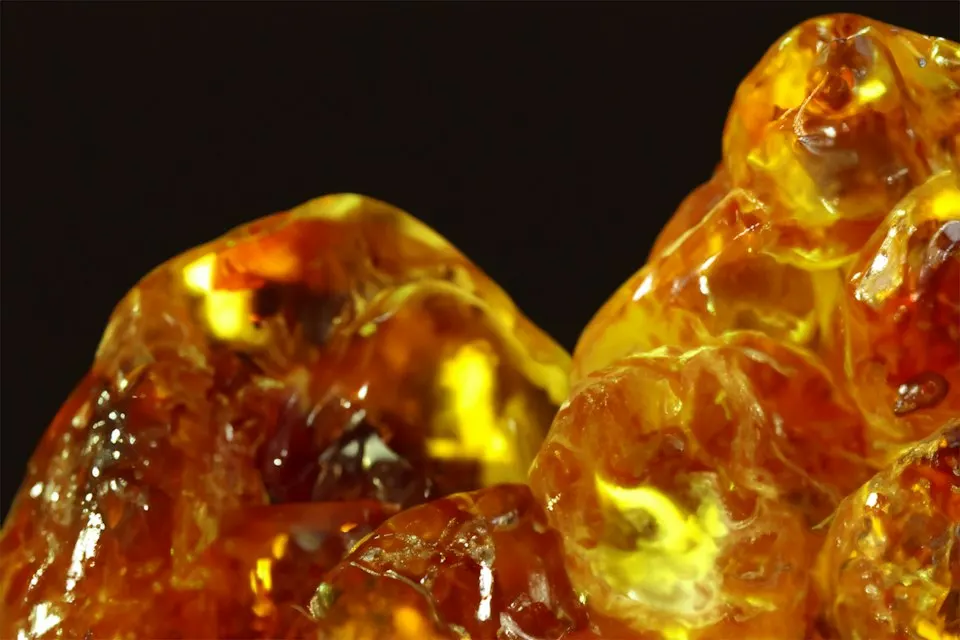
Collecting amber on Polish beaches is a hobby that may cover your petrol, but rarely more. A handful of small pieces after a storm is worth a few złoty. Real money only starts with pieces of a dozen grams or more and with rare finds that hold inclusions.
General information, not legal or tax advice. Current as of 30 October 2026; rules and prices change. Tax questions: Krajowa Informacja Skarbowa (+48 22 330 03 30). Collecting: the maritime office (Urząd Morski, Gdynia or Szczecin). Parks and reserves: the park or the regional environment directorate (RDOŚ). Polish laws: ISAP (isap.sejm.gov.pl).
What amber is worth per gram
The price per gram climbs steeply with size. A large, clean piece can be cut into beads or jewellery; small fragments go into pressed amber, liqueurs and powder, so they fetch the least. The table shows wholesale selling prices for raw Baltic amber, net of VAT. A buyer (skup) pays less, because it needs a margin.
| Piece size | PLN per kg | approx. PLN per gram |
|---|---|---|
| small fragments, under 1 g | 100–300 | 0.10–0.30 |
| 2–5 g | 791–1,055 | 0.79–1.06 |
| 5–10 g | 1,428–1,648 | 1.43–1.65 |
| 10–20 g | 2,901–3,450 | 2.90–3.45 |
| 20–50 g | 4,175–5,714 | 4.18–5.71 |
| 50–100 g | 7,691–8,570 | 7.69–8.57 |
| 100–200 g | 9,230–10,109 | 9.23–10.11 |
| 200–300 g | 10,768–11,208 | 10.77–11.21 |
Classes from 2 g: Gemur wholesale price list (30 October 2026). Fragments: Interia and BałtykTeraz (October 2026). A private OLX listing in Gdańsk (12 October 2026) asks 6,000 PLN per kg for 20–50 g, the top of the wholesale range. We found no current public buyer price lists, so we cannot say exactly what a buyer will pay.
What that means for your finds
- A handful of fragments after a storm, 20 g: 2–6 PLN at wholesale prices. Keep it as a souvenir.
- One 7 g piece: about 10–12 PLN wholesale, less at a buyer.
- One 30 g piece: about 125–170 PLN wholesale. Finds like this are rare.
- A piece with an inclusion (insect, plant): valued one by one, and it can be worth many times the raw material. Do not sell it by weight.
To be plain about it: for most collectors this is a hobby. A few grams after a storm buys a coffee, not a day's wage.
Raw or polished
The table covers raw amber. Polishing removes the weathered crust and some weight, so it pays off only for larger, clean pieces or as a keepsake. Shop jewellery costs far more per gram because you pay for labour, silver and margin.
Where to sell
- Amber buyers and workshops (skup bursztynu, pracownia). Mostly in and around Gdańsk, the centre of the trade. They pay by weight per size class: the simplest route for a larger amount of raw amber.
- Jewellers. Some buy single clean pieces from about a dozen grams up.
- Allegro, OLX, Vinted. Worth it for attractive single pieces, collections and inclusions. Give the weight, photos (also under UV) and the find spot. Do not write "certified" without a certificate.
- Amberif fair in Gdańsk. A trade fair (2026: 26–28 March, AmberExpo) for registered trade visitors. Good for learning the market, not for selling a bag of fragments.
Certificates and avoiding scams
The International Amber Association (Międzynarodowe Stowarzyszenie Bursztynników, MSB) runs a laboratory in Gdańsk that tests amber and issues certificates. A certificate confirms natural Baltic amber, not copal, plastic or pressed amber. It is worth it for valuable pieces and inclusions. Prices and orders are on amber.org.pl.
- Sort your amber by size before visiting a buyer, so you know what to expect.
- Check the scale has a valid verification mark (legalizacja) and watch the weighing.
- Compare two or three buyers, and do not let the whole lot go at the fragment price.
- Get a piece with an inclusion valued or certified before you sell it.
- When selling online, never click "receive payment" links from so-called buyers. It is a common card-data scam.
- Buying? Check the piece yourself: how to identify amber.
Watch out for white phosphorus from old munitions. It looks like pale amber and can ignite as it dries. Never put a suspicious find in your pocket.
Is it legal
Picking amber off the beach: yes, by hand
Picking up amber washed ashore by hand, on the beach and in shallow water at the shoreline, for your own use needs no permit. That is how the Maritime Office in Gdynia put it (RMF24, 16 November 2024). The office added that collecting must be by hand only, and that sieves, motor pumps and sluices are not allowed. Dunes and cliffs are off limits. Poland's Geological and Mining Law (Prawo geologiczne i górnicze, PGG) does not apply to collecting mineral specimens for collection purposes without mining works (art. 3 point 4). See where to find amber and amber collecting rules.
Digging and pumps: a licence is required
Under Polish law amber is a mineral resource (kopalina), and a natural accumulation of it is a deposit (art. 6(1) point 19 PGG). Extracting minerals from a deposit requires a licence (koncesja, art. 21(1) point 2), and at sea it is granted by the environment minister (art. 22(1) point 3). Digging pits, pumps, sluices and flushing out sand count as extraction. Without a licence you face an increased fee of 40 times the extraction fee rate multiplied by the amount extracted (art. 140(3) point 3), plus detention or a fine (art. 177), and up to 3 years in prison if you cause significant damage (art. 176).
National parks and reserves: forbidden
Taking amber is forbidden in national parks and nature reserves (art. 15(1) point 8 of the Nature Conservation Act). Deliberate breaches carry detention or a fine (art. 127). This covers the beaches of Słowiński National Park between Łeba and Rowy, and of Woliński National Park between Międzyzdroje and Międzywodzie. Woliński NP also includes a strip of sea one nautical mile wide. There are reserves at the mouth of the Vistula (Mewia Łacha, Ptasi Raj). Natura 2000 sites have no explicit ban on picking up amber, but activities that significantly harm their habitats are forbidden (art. 33). Check boundaries in the GDOŚ geoservice.
The technical belt and the border
Beaches and dunes usually lie in the coastal technical belt (pas techniczny). There you may not litter, light fires or drive without the maritime office's consent, or enter fenced or signed works and erosion areas (art. 37(2a) of the Maritime Areas Act, fine under art. 60c). Do not dig at the foot of dunes or cliffs, and avoid sites where sand is being pumped onto the beach. On the Vistula Spit near the Russian border there is a border strip. Where signs read "Pas drogi granicznej – wejście zabronione", you do not enter (art. 9 of the State Border Protection Act).
Diving
No rule deals directly with divers collecting amber. The maritime office speaks of the beach and shallow foreshore, and the seabed in Polish sea areas is State Treasury mining property (art. 10(4) PGG). Safe practice: take only loose pieces by hand, do not flush the seabed, use no pumps, and ask the maritime office before regular amber dives. Diving on a wreck needs a permit from the director of the maritime office unless the wreck is on the exempt list (art. 35a of the Maritime Areas Act). Take nothing from wrecks, and report historic objects to the regional heritage conservator. More in amber underwater.
Tax
- Occasional sales of your own finds. Selling an item within six months, counted from the end of the month you acquired it, is taxable income under Polish PIT (art. 10(1) point 8(d) of the PIT Act). After that period no PIT is due, as long as you are not running a business. The law does not say clearly whether finding amber counts as acquiring it. If you sell quickly or for larger sums, ask KIS.
- Regular trading. Organised, continuous selling is business activity (art. 5a point 6 of the PIT Act). In 2026 you may earn up to 225% of the minimum wage per quarter, 10,813.50 PLN, without registering a business, if you have not run one in the last 60 months (art. 5(1) of the Entrepreneurs' Law). The income still goes on your annual PIT return. Collecting in order to sell also goes beyond the amateur, own-use collecting the maritime office describes.
- Platforms report. Allegro, OLX and Vinted report sellers with 30 or more sales, or over 2,000 euro, in a year to the tax office (art. 75a point 24(d) of the Act on Exchange of Tax Information, EU DAC7).
Sending amber abroad
We found no export limit for ordinary raw amber in Polish law. Exporting fossil remains of plants and animals needs a permit from the General Director for Environmental Protection, GDOŚ (art. 121(2) of the Nature Conservation Act). The act does not say whether amber with an inclusion counts, so ask GDOŚ before sending one abroad. The same act requires anyone who discovers fossil remains of plants or animals to notify the regional environmental directorate (RDOŚ) without delay (art. 122(1)). Whether that covers inclusions in amber is also unclear. For an exceptional piece, ask the RDOŚ. Parcels leaving the EU go through customs at the destination.
Sources
- Geological and Mining Law (PGG), consolidated text, Dz.U. 2026 item 69 (checked 30 Oct 2026)
- Nature Conservation Act, consolidated text, Dz.U. 2026 item 1315 (checked 30 Oct 2026)
- Maritime Areas and Maritime Administration Act, consolidated text, Dz.U. 2026 item 1305 (checked 30 Oct 2026)
- State Border Protection Act, consolidated text, Dz.U. 2026 item 919 (checked 30 Oct 2026)
- Personal Income Tax (PIT) Act, consolidated text, Dz.U. 2026 item 592 (checked 30 Oct 2026)
- Entrepreneurs' Law, consolidated text, Dz.U. 2025 item 1480, art. 5(1) from 1 Jan 2026 (checked 30 Oct 2026)
- Act on Exchange of Tax Information with Other States, consolidated text, Dz.U. 2025 item 1379 (checked 30 Oct 2026)
- money.pl: unregistered activity in 2026, limit 10,813.50 PLN (Polish) (checked 30 Oct 2026)
- Infor: selling a collection and PIT, KIS ruling of 11 March 2026 (Polish) (checked 30 Oct 2026)
- RMF24: amber collecting rules according to the Maritime Office in Gdynia, 16 Nov 2024 (Polish) (checked 30 Oct 2026)
- Gemur: raw amber price list (Polish) (checked 30 Oct 2026)
- Interia: what amber costs and why (Polish) (checked 30 Oct 2026)
- BałtykTeraz: amber prices 2026 (Polish) (checked 30 Oct 2026)
- OLX: Gdańsk listing, 20–50 g pieces, 12 Oct 2026 (Polish) (checked 30 Oct 2026)
- AmberExpo: AMBERIF Spring 2026 (checked 30 Oct 2026)
- International Amber Association (MSB): laboratory and certificates (checked 30 Oct 2026)
- Międzyzdroje.pl: Woliński National Park (checked 30 Oct 2026)
Do not miss the next window
The best windows last a few hours: after a storm, after rain, on a clear night with an active Sun. Sign up and we will email you when the index at your spots goes above 60.