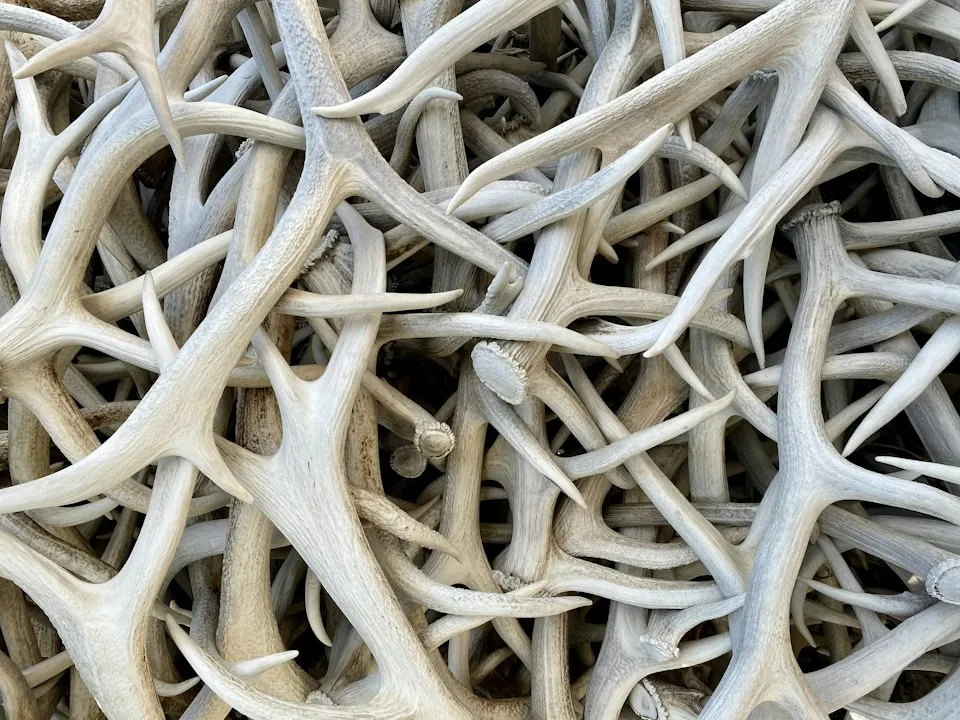
Sheds lie where animals spend the end of winter. If you know their winter habits, you will find antlers far more often than someone who wanders at random. Here is where to look and how to work the ground.
Start with winter range
At the end of winter deer and moose save energy. They stay in small areas with food and cover, close together. Such places are:
- South-facing slopes: snow melts fastest and the sun warms them. In mountains this is the core of winter range.
- Edges of meadows and fields next to forest: animals feed there at night and spend the day in nearby thickets.
- Valleys with streams: water, brush and shelter from the wind.
- Young stands and thickets: daytime bedding areas. In Poland many are wildlife refuges or plantations with a no-entry sign, so search their edges, not the inside.
Crossings and obstacles
An antler loosens before it falls and drops off with a jolt. So good places are where the animal jumps or ducks:
- crossings over ditches, streams and low fences,
- fallen trees across a trail,
- steep banks that animals use to reach water,
- narrow necks of land between lakes or bogs.
Worn trails between bedding and feeding areas are the best lines to walk. Walk along them, but a few metres to the side, so you do not leave scent on the trail itself.
Feeders and food plots
In Poland hunting clubs feed game in winter and plant food plots. Animals visit them regularly, so sheds are often nearby. But these are also the places where animals are most sensitive. Do not go there when you see animals or fresh tracks, and do not hang around a feeder. A hunting club may simply not want strangers near its feeders, so it is worth asking.
When to go: after snowmelt
The best moment is the first days after the snow goes following a snowy winter. Snow held the animals in small areas, so the sheds are concentrated. The ground is still flat and brown, the grass has not grown, and the antlers are fresh and dark. Every week of delay means more competition, more grass and more chewed sheds, because rodents gnaw antler for calcium.
After a winter with no snow, animals spread out more and sheds are scattered. The search then takes longer.
How to work the ground
- Walk slowly. Most sheds are missed through hurry. Walking pace is too fast.
- Look for a shape, not a whole antler. Often you see only a curved piece of beam, a white tine tip or the burr at the base.
- Work in strips. Cover the ground in parallel strips 10 to 20 metres apart, depending on visibility.
- Use binoculars. On open slopes and meadows they save hours of walking.
- Look with and against the sun. Low morning and evening light picks out shapes, and at midday antlers shine.
- After the first antler, look for the second. Search a circle of one or two hundred metres along the line of the trail.
Wind and animals
If animals are still in the area, do not walk into their ground. Keep the wind in your face. Animals then cannot scent you and will not run. When you see animals, back off and come back later. Running costs them energy they have little of at the end of winter. More in our guide on shed hunting ethics.
What to take
- Binoculars for glassing meadows and slopes from a distance.
- An offline map with the boundaries of parks, reserves and military areas.
- A pack with straps or a cord, because a pair of big red deer or elk sheds weighs several kilograms and has sharp tines.
- A bright vest or cap, so hunters can see you from far away.
- A notebook or phone to record where and when you found each antler.
Safety
- Hunting: in Poland wild boar are hunted all year, and the red deer stag season still runs in February. Wear a bright vest and avoid areas with driven hunts.
- Ticks: they are active from early spring. Check yourself when you get home.
- Navigation: shed hunting is off-trail, so it is easy to get lost. Carry an offline map with park and reserve boundaries.
- Unexploded ordnance: on former military ranges, such as in the Lower Silesian Forest, do not pick up metal objects.
- Dead wild boar: in Poland report them to the district veterinary officer or the forest district because of African swine fever. Do not touch them.
- Western US: carry water, watch the weather and expect mud and snowdrifts on high ground in May.
Where to go
In Poland the most red deer live in big forests: the Bieszczady, the Low Beskids, the Lower Silesian Forest and the Noteć and Drawa forests. Moose are mainly in Podlasie, the Janów Forests and around Kampinos. In the US the classic areas are elk winter ranges in Wyoming, Colorado, Montana, Idaho and Utah. The list of spots with a forecast is on the shed antler forecast page. Always check the boundaries of national parks and reserves, because collecting antlers is banned there.
Sources
- Polish Forest Act, consolidated text Dz.U. 2024 item 530
- Art. 15 of the Polish Nature Conservation Act
- Idaho Fish and Game, 2026 rules (advice for shed hunters)
- Utah DWR, Antler gathering
Do not miss the next window
The best windows last a few hours: after a storm, after rain, on a clear night with an active Sun. Sign up and we will email you when the index at your spots goes above 60.