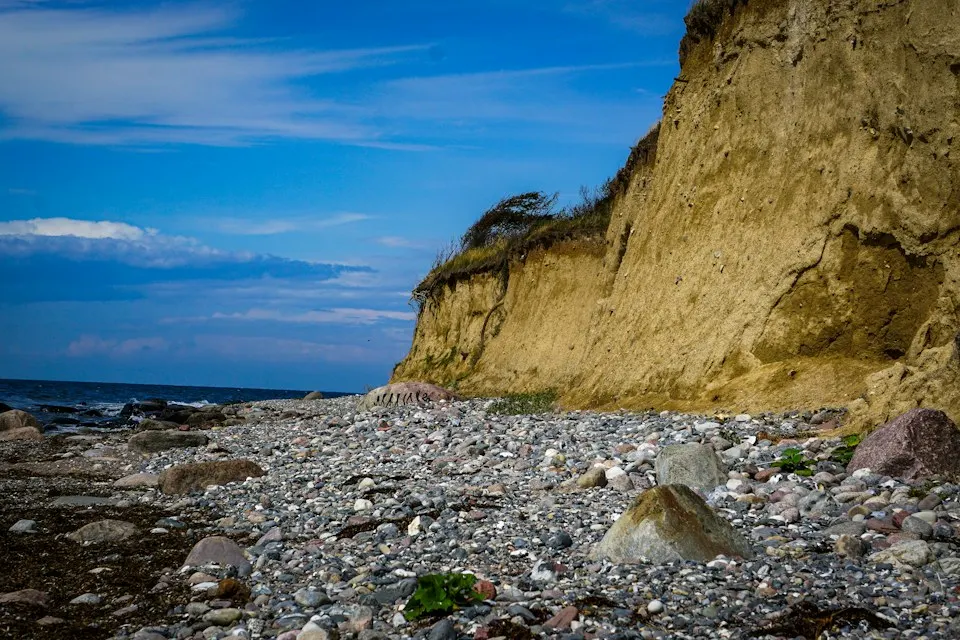
Fossils on a Polish beach rarely come from the cliff itself. The ice sheet carried them in with the stones, and the sea washes them out of the clay and leaves them on the shore. Here is a tour of the places from west to east.
Where they come from
During the ice ages the ice sheet carried rock from Scandinavia and from the Baltic seabed. One patch of gravel can therefore hold fossils from several periods. The Baltic cliffs are made mostly of glacial till, sand and gravel. When waves cut at the cliff, the clay and sand wash away and the heavy stones stay behind. That is how the gravel bands form, and they are where you find the most.
So you are collecting what the sea has washed out: Cretaceous belemnites, sea urchins and sponges in flint, and Palaeozoic limestones with corals and brachiopods. At Chłapowo you can also find Miocene fossil wood.
West Pomerania
The longest cliff stretch is made of four places: Pobierowo, Trzęsacz, Rewal and Niechorze. The cliff is up to about 17 m high. At Rewal and Śliwin the till contains pieces of older bedrock, including Cretaceous claystones. Start at Rewal or Trzęsacz.
Further east is Ustronie Morskie, where the cliffs are similar till with sand and gravel. In the west is Dziwnówek and Łukęcin. The Jurassic near Kamień Pomorski is known from boreholes, not from outcrops on the beach. In the forest behind Dziwnówek there is an old quarry with a Jurassic limestone raft, with corals and ammonites. It is not a beach, so do not go in without checking the status of the site.
Central Pomerania
Jarosławiec and Wicko Morskie have an active cliff of till and sand. There are fewer fossils here than in the west, and your chances rise after a long storm from the north-west.
Gdańsk Pomerania
Jastrzębia Góra and Rozewie have cliffs of till, sand and clay that slump quickly. Chłapowo is different: the cliff exposes Miocene sands with brown coal. You can find pieces of fossil wood and leaf impressions in the coal. The nature reserves Cape Rozewie and the Rudnik gorge are next door, and you take nothing from them.
The Tricity
The best described cliffs are in Gdynia. Below the cliff at Orłowo, researchers found trilobites in Silurian limestone erratics. The cliff belongs to a reserve, so look and photograph, do not collect. For Babie Doły and Mechelinki the Polish Geological Institute lists corals, sponges, brachiopods and bivalves. Vertebrae of marine reptiles, plesiosaurs and mosasaurs, have also been found in glacial material from the Gdynia cliffs. They are rare.
Where you may not collect
In national parks and nature reserves you may not take fossils. This applies to Wolin National Park, whose Gosań and Kawcza Góra cliffs stand on the sea, and to Słowiński National Park. The full rules are in the guide rules and cliff safety.
How to choose a beach for today
Every beach faces a different way, so the same storm gives different results. Check the fossil forecast, and read about timing in when to look for fossils.
Email alert
Do not miss the next window
The best windows last a few hours: after a storm, after rain, on a clear night with an active Sun. Sign up and we will email you when the index at your spots goes above 60.