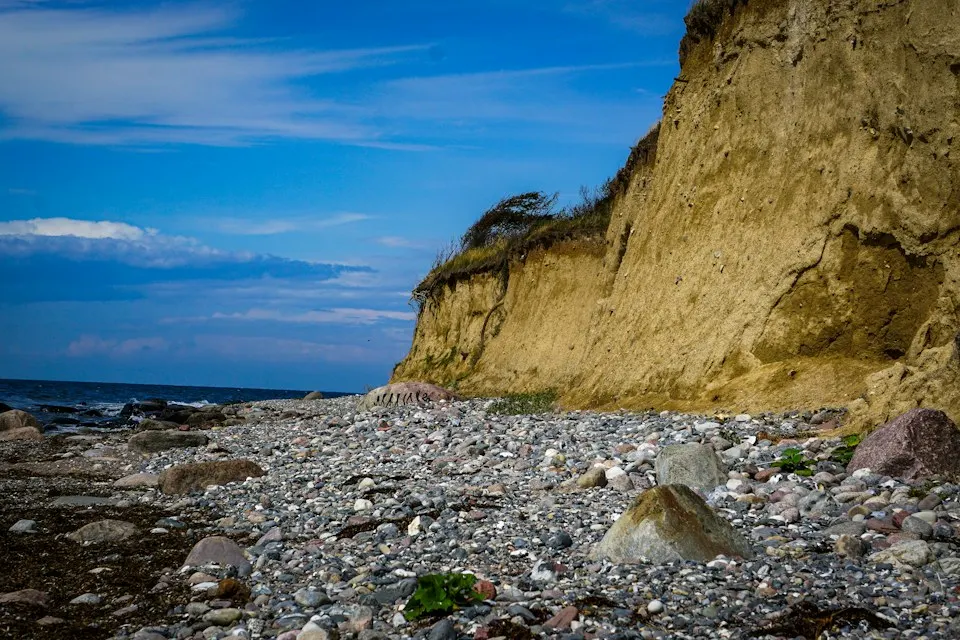
You can sell fossils from the beaches below Polish cliffs if you collected them legally: loose, from the beach surface, outside national parks, nature reserves and other protected sites. The money is small. Most belemnites and sea urchins are worth a few złoty, good pieces a few dozen. Treat it as a hobby that may cover your petrol, not as an income.
This is not legal or tax advice. It is general information, current as of 30 October 2026. Rules and prices change. For tax questions, call the National Tax Information service (Krajowa Informacja Skarbowa, +48 22 330 03 30) or ask a tax adviser. For the boundaries of protected areas, ask the regional environmental directorate (RDOŚ) or check the GDOŚ map service.
What it is worth
Listing prices are asking prices. Many listings sit unsold for months, so the real selling price is often lower. The ranges below come from OLX listings in October 2026.
| Find | Listing prices | Notes |
|---|---|---|
| Belemnite | 5-50 zł each, lots of 10-15 for 35-40 zł | The most common find. In a lot it works out at 3-4 zł a piece. |
| Sea urchin in flint | 12-50 zł, one listing about 110 zł | A complete test and clear pattern matter most. |
| Sponge in flint | no separate listings | Usually sold in mixed lots. |
| Trilobite | 59-149 zł for Moroccan pieces | We found no listings for trilobites from Baltic erratic boulders. |
| Ammonite | from a few zł (3 for 15 zł) | Rare on Polish beaches. |
| Petrified wood | mostly 15-120 zł | Listings are mainly from Lower Silesia or imported. |
A few beach pieces are listed for hundreds of złoty. One example: Silurian limestone with fossils from the beach at Kołobrzeg, listed for 599 zł. That is a wish price, not proof that anyone paid it.
What can be valuable
- Complete specimens. A sea urchin with an intact test, or a trilobite with head and body in the rock.
- Rare groups. Bones and teeth of marine reptiles matter mainly to science. See below.
- Well-documented pieces. Locality, date and identification add value for collectors.
We do not give prices for rare pieces. There are too few listings from the Polish coast to price them honestly. For identification, see our guides to belemnites and to sea urchins and sponges in flint.
Where collecting is allowed and where it is not
Outside protected areas you can pick up a loose specimen from the beach surface, by hand and in small amounts. The bans apply to specific places:
- National parks and nature reserves. Article 15(1)(8) of the Nature Conservation Act (ustawa o ochronie przyrody) bans taking rocks, fossils (including fossil remains of plants and animals), minerals and amber. Point 6 bans damaging or altering natural features.
- Wolin National Park (Woliński Park Narodowy). The Gosań and Kawcza Góra cliffs are inside it. Since 1996 the park has also covered a one-nautical-mile strip of coastal water. Treat the beach below the cliffs as part of the park: take nothing and sell nothing from there.
- Kępa Redłowska and the Orłowo cliff (Klif Orłowski). The cliff is in a nature reserve. The Natura 2000 site Klify i Rafy Kamienne Orłowa (PLH220105) covers the cliff and the narrow beach at its foot. At Orłowo, look and take photos, but do not collect.
- Natural monuments and documentation sites (pomniki przyrody, stanowiska dokumentacyjne). Article 45(1) allows bans on damaging the feature and on extracting rocks and fossils for commercial purposes. Collecting to sell is a commercial purpose. The exact bans are in the local resolution that created the site, so check it.
- Natura 2000. There is no general ban on picking up stones. Cliffs are a protected habitat, though, and damaging them can conflict with the site's conservation goals.
- The technical belt (pas techniczny). Article 37(2a) of the Maritime Areas Act bans littering, fires without permission, and entering fenced or signed areas under works or at risk of erosion without authorisation. Keep off coastal defences.
Deliberately breaking the bans in a national park, reserve, landscape park, protected landscape area or Natura 2000 site is punishable by detention or a fine (Article 127 of the Nature Conservation Act).
Beach yes, cliff no
Do not dig into the cliff face or use a hammer or crowbar, even outside protected areas. In a reserve it breaks the ban. Anywhere, it damages the coast and can trigger a landslide. Safety rules are in our guide to fossil hunting rules and cliff safety.
Do you need a permit to sell?
We found no rule requiring a permit to sell legally collected geological specimens. A fossil is not a heritage object. The Polish heritage act covers things "made by man or connected with his activity", and an archaeological monument is a remnant of "human existence and activity". A belemnite meets neither test.
A specimen taken from a national park or reserve was collected illegally. Do not offer it for sale.
Shipping abroad. Exporting meteorites and fossil remains of plants and animals from Poland requires a permit from the General Director for Environmental Protection, GDOŚ (Article 121(2) of the Nature Conservation Act). The rule has no value threshold and no exception for EU countries, so as written it also covers a single belemnite posted to a buyer in Germany. We found no information on how GDOŚ applies it to cheap single specimens. Ask GDOŚ before your first shipment abroad, and do not ship without an answer. Separately, Poland requires a permit to export palaeontological collections and items from mineral collections worth over 16,000 zł, and outside the EU an export licence is also needed for collections of palaeontological interest worth 50,000 euro or more (Council Regulation (EC) No 116/2009). Beach finds rarely reach these two thresholds. The buyer's country may have its own import rules.
Where to sell
- OLX, Allegro, Allegro Lokalnie. The simplest option for single pieces and lots.
- Etsy and eBay. They reach buyers abroad, but postage often eats the profit. Sending fossils abroad needs a GDOŚ permit (see above).
- Mineral fairs (giełdy minerałów). For the rest of 2026 the PTPNoZ calendar lists Łódź (7-8 November), Kielce (21-22 November) and Kraków (5-6 December). Worth it for a larger, documented collection. Ask the organiser about stall terms.
How to label a specimen honestly
- Name and age, if you know them. If not, write "identification uncertain".
- Locality and how it was found: "found loose on the beach at Rewal (znalezione na plaży), 2026". Do not write "from the cliff" if it was not.
- Size, condition and damage. Say if it was glued, polished or cleaned with chemicals.
- A photo with a scale (a ruler or a coin).
- Do not mix your own finds with bought ones, and do not give bought pieces a Baltic origin.
Fakes
Most fakes are Moroccan trilobites: resin casts, composites glued from parts of different animals, and real specimens with missing parts filled in. The American Museum of Natural History advises checking for air bubbles with a hand lens, using a UV torch to spot repairs, and distrusting batches of identical specimens. If someone sells you a "Baltic" piece, ask where and when it was found.
An important find: report it, do not sell it
Fragments of mosasaur and plesiosaur bones have been found in glacial material from the Gdynia cliffs and described by researchers at the Polish Geological Institute. If you find a bone, a tooth or anything unusual:
- Photograph it where it lies, with a scale, and note the GPS position.
- Do not clean, glue or varnish it.
- Notify the regional environmental directorate (RDOŚ in Gdańsk or Szczecin) or, if that is not possible, the local mayor (wójt, burmistrz). Also contact the Polish Geological Institute (PIG-PIB), ideally its Marine Geology Branch in Gdańsk, or the earth sciences department of the nearest university.
Anyone who discovers fossil remains of plants or animals must notify the RDOŚ without delay (Article 122(1) of the Nature Conservation Act). Failing to do so is a petty offence punishable by detention or a fine (Article 131 point 11). If the RDOŚ finds the specimen valuable to science, it passes it to a museum or research institution (Article 122(3)). The rule does not distinguish a common belemnite from a reptile bone, and we found no guidance on how the RDOŚ applies it to ordinary beach finds. This is uncertain, so if in doubt, ask the RDOŚ.
A well-documented specimen can add to science. No online listing will reflect that value.
Tax
Occasional sales. Selling personal belongings outside a business is taxable only if the sale happens within six months from the end of the month in which you acquired the item (Article 10(1)(8)(d) of the Polish personal income tax act). Finding a specimen is most likely treated as acquiring it. We found no tax ruling on beach fossils, so this is uncertain. After six months a sale normally triggers no income tax. Before that, you declare the income on the annual PIT-36 return.
Regular selling. If you collect in order to sell, keep listing all the time or buy specimens to resell, it can count as an organised and continuous business. The six-month rule then no longer protects you. Without registering a business you may earn up to 10,813.50 zł in revenue per quarter (225% of the 2026 minimum wage of 4,806 zł). Unregistered activity (działalność nierejestrowana) is declared on PIT-36 (Article 20(1ba) of the PIT act). Once you exceed the limit, you have 7 days to register with CEIDG.
Platforms report sales. Under DAC7, platforms send the tax authority data on sellers who had at least 30 sales or more than 2,000 euro in a year. A report does not mean tax is due, but the tax office sees your sales. These rules apply to Polish tax residents. If you live elsewhere, check your own country's rules.
Current beach conditions are in our fossil forecast.
Sources
- Nature Conservation Act, Art. 15: bans in national parks and reserves (Polish) (checked 30 Oct 2026)
- Nature Conservation Act, Art. 45: natural monuments and documentation sites (Polish) (checked 30 Oct 2026)
- Nature Conservation Act, Art. 127: penalties (Polish) (checked 30 Oct 2026)
- Nature Conservation Act, consolidated text, Dz.U. 2026 item 1315 (Art. 121(2), 122, 131 point 11, Polish) (checked 30 Oct 2026)
- GDOŚ: Natura 2000 standard data form PLH220105 (checked 30 Oct 2026)
- Institute of Oceanology PAN: statement on the Orłowo cliff (Polish) (checked 30 Oct 2026)
- Międzyzdroje municipality: nature and Wolin National Park (Polish) (checked 30 Oct 2026)
- Maritime Areas Act, Art. 37: the technical belt (Polish) (checked 30 Oct 2026)
- Heritage Protection Act, Art. 3: definitions (Polish) (checked 30 Oct 2026)
- Ministry of Culture: items requiring an export permit (Polish) (checked 30 Oct 2026)
- Council Regulation (EC) No 116/2009, Annex I (checked 30 Oct 2026)
- Personal Income Tax Act, Art. 10 (Polish) (checked 30 Oct 2026)
- Infor: 2026 limits for unregistered activity (Polish) (checked 30 Oct 2026)
- Poradnik Przedsiębiorcy: annual PIT for unregistered activity (Polish) (checked 30 Oct 2026)
- podatki.gov.pl: digital platform information (DAC7, Polish) (checked 30 Oct 2026)
- OLX listings: belemnites, sea urchins, trilobites, petrified wood and Baltic fossils (checked 30 Oct 2026)
- PTPNoZ: 2026 mineral fair calendar (Polish) (checked 30 Oct 2026)
- AMNH: Fake Trilobites (checked 30 Oct 2026)
- Przegląd Geologiczny 2025: marine reptile bones in glacial deposits of Gdańsk Pomerania (Polish) (checked 30 Oct 2026)
Do not miss the next window
The best windows last a few hours: after a storm, after rain, on a clear night with an active Sun. Sign up and we will email you when the index at your spots goes above 60.