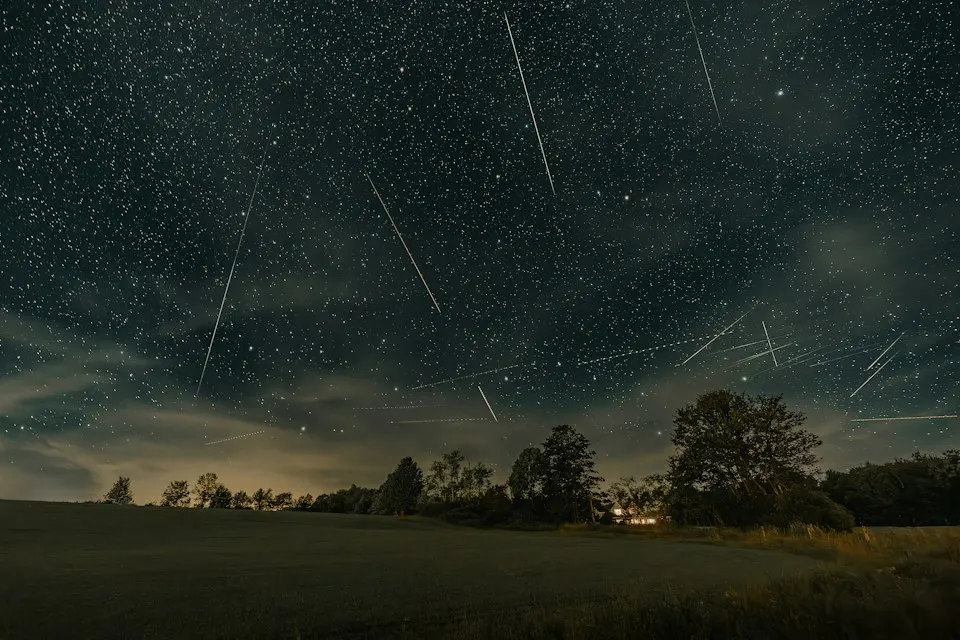
Poland has several famous meteorites and a growing number of new falls, because fireball camera networks now work out landing areas to within a few hundred metres. The most important site, Morasko in Poznań, is a nature reserve where searching and digging are not allowed without a permit.
Morasko: an iron shower 5,000 years ago
Morasko is an iron meteorite of the IAB group that broke up in the atmosphere thousands of years ago. Dating puts the fall between 4100 and 2700 BC, while other estimates give 5,000 to 5,400 years. The first piece, 77.5 kg, was dug up on 12 November 1914 while trenches were being built. The impacts left several craters on the northern edge of Poznań, the largest about 90 to 100 m across.
To protect the craters, the Meteoryt Morasko nature reserve was created on 24 May 1976. It covers about 54 ha, with a buffer zone of over 100 ha, and is looked after by the Łopuchówko forest district. The reserve falls under the Nature Conservation Act: you may not leave the trails, damage the soil, dig, or take rocks or minerals. The largest pieces found inside the reserve, 164 kg in 2006 and 261 kg in 2012, were recovered by teams working with the Institute of Geology at Adam Mickiewicz University. The 261 kg mass is now in the university's Earth Museum in Poznań.
The area around the reserve has been searched many times. The largest known Morasko mass, "Kruszynka", about 272 kg, was found outside the reserve in 2017 and went into a private collection. Around the reserve there are state forests, fields and private plots, so any search needs the landowner's consent, and digging in a forest needs the forest district's consent.
Pułtusk 1868: thousands of stones in the fields
On 30 January 1868 a shower of stony meteorites fell north-east of Pułtusk. It is an H5 ordinary chondrite. According to figures collected on Polish Wikipedia, the pieces spread over about 127 km², tens of thousands were collected, mostly a few grams each, and the largest weighed about 9 kg. Pułtusk specimens are in museums around the world and often appear on the collector market. The strewn field has been searched many times, and most of the land is private.
Łowicz 1935: a rare mesosiderite
On the night of 11 to 12 March 1935 a shower of stony-iron meteorites of the mesosiderite type fell south of Łowicz. This rare group is a mix of metal and silicate rock. About 59 kg was collected in total, and the largest piece, almost 10 kg, was found near the village of Krępa. Pieces are held by the Earth Museum of the Polish Academy of Sciences and by university collections.
Recent falls: from Sołtmany to Zadzim
- Sołtmany, 30 April 2011. An L6 chondrite of about 1 kg crashed through the roof of an outbuilding at a guest farm in Masuria.
- Antonin, 15 July 2021. Cameras of the European Fireball Network in Czechia filmed a daylight fireball. From its path, searchers found a 350 g L5 chondrite in a field near Antonin in Greater Poland on 3 August.
- Drelów, 18 February 2025. Ten cameras of the Polish Skytinel network recorded a fireball over the Lublin region. Within a few weeks, about 60 pieces of L6 chondrite were found, about 3.9 kg in total.
- Zadzim, 17 April 2026. A fireball over the Łódź region was recorded by 24 stations. Five days later a single iron meteorite of 2,896 g was found. It is the first observed iron meteorite fall in Poland.
The Polish Fireball Network and other camera networks
The Polish Fireball Network (PFN) has been running since 2004. It is operated by the Comets and Meteors Workshop (PKiM) with the Nicolaus Copernicus Astronomical Center of the Polish Academy of Sciences. By the end of 2016 it had over 30 stations with more than 70 cameras. The cameras record meteors over Poland, and observations from several stations give the trajectory, the orbit and a possible fall area. Not every predicted fall ends in a find. For a fireball over Warmia on 12 September 2016, the fall area lay in Lake Kławój and in wetland near Reszel, and despite searches no meteorite was found. Alongside the PFN, the Skytinel network worked out the fall areas for Drelów and Zadzim.
Where people search
- Fresh strewn fields. Most Polish finds come from areas calculated by the fireball networks in the days after a fall. The first days matter most, before rain and ploughing bury the stones.
- Ploughed fields in spring and autumn. A dark stone with a black crust is easier to spot on bare soil. Remember that every field has an owner.
- Around Morasko, outside the reserve. With a metal detector and the landowner's consent. Digging in state forests needs the forest district's consent.
Before you head out, read is it legal to search for and sell meteorites and learn how to recognise a meteorite. If you saw a bright fireball, report it to PKiM or through the IMO fireball form. Several witness reports help work out the trajectory.
Sources
- Morasko meteorite (Wikipedia, in Polish)
- Morasko meteorite nature reserve (Wikipedia)
- Pułtusk meteorite (Wikipedia, in Polish)
- Łowicz meteorite (Wikipedia, in Polish)
- Sołtmany meteorite (Wikipedia, in Polish)
- Antonin meteorite (Wikipedia, in Polish)
- Drelów meteorite (Wikipedia, in Polish)
- Zadzim meteorite (Wikipedia, in Polish)
- Polish Fireball Network (Wikipedia, in Polish)
- Comets and Meteors Workshop (PFN)
- Polish Nature Conservation Act, consolidated text, art. 15
Do not miss the next window
The best windows last a few hours: after a storm, after rain, on a clear night with an active Sun. Sign up and we will email you when the index at your spots goes above 60.