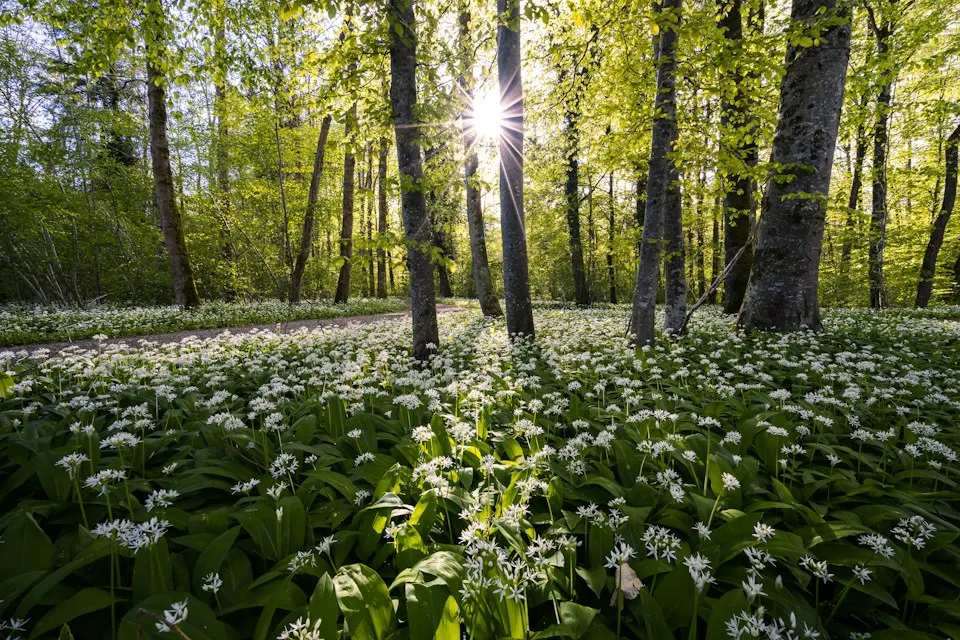
A good herb spot is not only one where plenty grows. It must also be clean, and it should still be rich after your visit. This guide covers where not to pick, how much to take and how to wash what you bring home.
Where not to pick
- By busy roads and railways: plants collect dust, soot and road salt. Weedkillers are used on railway banks and verges. Walk well into the meadow or wood, away from traffic.
- In parks, on greens and along popular paths: this is where dogs relieve themselves. Dog and cat droppings can carry parasite eggs.
- On field margins: crops are often sprayed with pesticides and fertilised, and spray drifts on the wind. You cannot know what was used or when, so avoid these places.
- Near drains, landfill and industrial sites: soil and water may be contaminated.
- On pasture just after grazing: plants are soiled by animal droppings.
- Where invasive plants were controlled: hogweed and knotweed are often sprayed, and plants nearby may carry residues.
Fox tapeworm: a risk for low-growing plants
Alveolar echinococcosis is a serious disease caused by the larvae of the fox tapeworm (Echinococcus multilocularis). Adult worms live in the gut of foxes, and also dogs and cats. Their eggs reach the forest floor, grass, bilberries, wild strawberries and mushrooms in droppings. You cannot see or smell them. Polish sanitary inspectors warn against eating wild berries straight from the bush. The parasite is common in parts of central Europe, including Poland, Germany, Switzerland and eastern France, and has not been found in the UK.
The risk applies to everything that grows close to the ground: wild strawberry leaves and fruit, bilberries, chickweed, wood sorrel, dandelion and sorrel. Elder and lime flowers picked high on a tree carry less risk, but wash those too.
- Wash herbs and fruit thoroughly under running lukewarm water, in small batches, moving them gently by hand. This is the advice of the sanitary station in Świnoujście.
- Washing does not give 100% certainty, but it clearly reduces the risk.
- Home freezing does not kill the eggs. According to the Warsaw regional sanitary inspectorate, they survive almost two months even at minus 27°C.
- Heating above 60°C for several minutes, for example when making jam, kills the eggs.
- Wash your hands with soap after picking and before eating, and deworm dogs regularly.
How much to take
Wild patches are easy to strip, especially near towns and car parks. A few simple rules:
- Take at most a third, and nothing from a small or rare patch. Polish rules for some protected species require leaving at least 75% of the population, and that is a good measure for other plants too.
- Do not pull up roots. Cut with scissors or a small knife. In the UK uprooting without permission is an offence, and in Polish forests digging and damaging plants is banned.
- Pick a little from many plants, not everything from one clump.
- Leave flowers for insects and fruit for birds. Lime, elder and meadowsweet are important for bees.
- Stay off meadows before mowing. Trampled grass is a loss for the farmer.
- Take only what you will use. A kilo of fresh nettle wilts in a day.
How to pick and carry
Use an airy basket, a cloth bag or paper bags. In a plastic bag, herbs sweat within half an hour. Keep each species separate, so that a stray poisonous leaf is easier to spot at home. Pick on a dry day, once the dew has dried. Lay elder and lime flowers loosely, heads up.
How to wash and dry
At home, sort the harvest on a light worktop, piece by piece. Throw out anything you are unsure of, anything dirty, mouldy or carrying insect eggs. Wash leaves and fruit for eating raw under running water and pat them dry on kitchen paper.
Elder and lime flowers are not washed before drying, because they lose pollen and scent and go mouldy easily. So pick them only from clean places, away from roads and from higher branches. Dry herbs in the shade, somewhere airy, in a thin layer, at up to about 35 to 40°C. Store them in airtight jars away from light, labelled with the species and date.
Respect for owners and others
Meadows, orchards and pastures almost always belong to someone. Ask permission, close gates and do not drive onto forest roads unless a sign allows it. Woods and meadows hold ticks, so check your skin when you get home.
Sources
- Warsaw regional sanitary inspectorate: wild berries and fox tapeworm (Polish)
- Świnoujście sanitary station: berries straight from the bush (Polish)
- Echinococcus multilocularis, parasite account
- Wildlife and Countryside Act 1981, s. 13
- Polish Forest Act, consolidated text 2026 item 663
- Polish Regulation on plant species protection, annex 3
Do not miss the next window
The best windows last a few hours: after a storm, after rain, on a clear night with an active Sun. Sign up and we will email you when the index at your spots goes above 60.