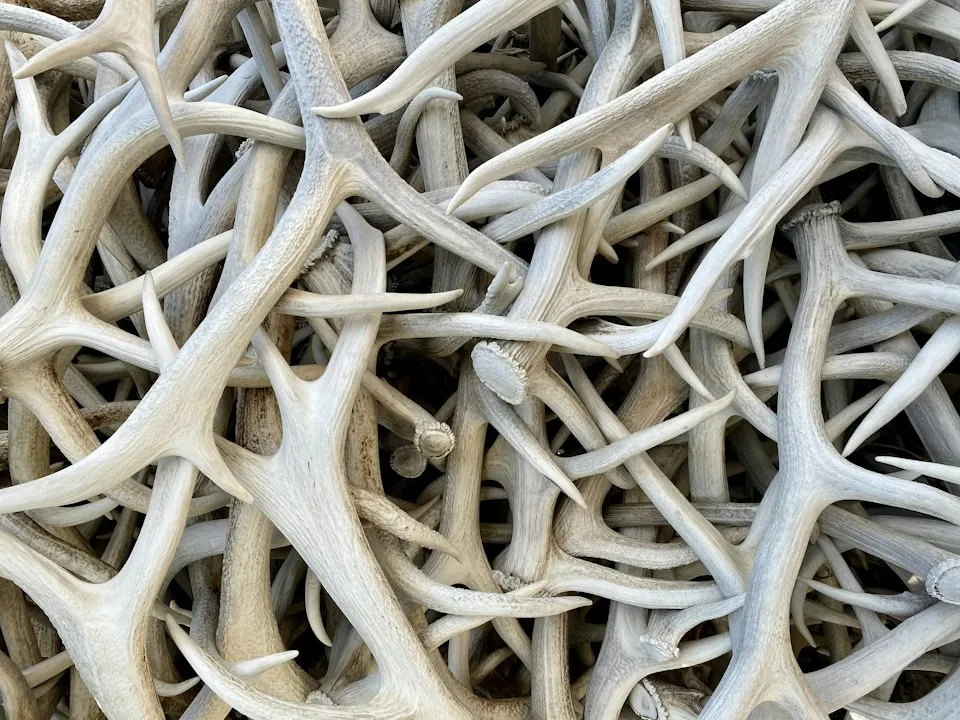
Red deer, roe deer, moose and fallow deer lose their antlers every year and grow new ones. Each species does it at a different time, so shed hunting has several seasons. This guide gives the calendar and explains what moves the dates.
Why antlers fall off
An antler is bone that grows from the pedicles, two short stalks on the skull. Its growth and attachment depend on testosterone. When the hormone level drops after the rut, a separation layer forms at the base of the antler. After a few days or weeks the antler falls off by itself, often when the animal jumps, brushes against a branch or crosses a fence.
The two antlers rarely fall in the same place. They usually land a few metres to a few hundred metres apart, sometimes days apart. So when you find one, search the area for the other.
Shedding calendar in Poland and Central Europe
| Species | When it sheds | When to search |
|---|---|---|
| Red deer | February to April, most in March | March to May |
| Roe deer (buck) | October to December, young bucks into January | November to March |
| Moose (European elk) | November to February | December to April |
| Fallow deer | April and May | April to June |
The dates are approximate. They vary between regions and years by two or three weeks.
Red deer
The oldest and strongest stags shed first, often at the end of February. Younger stags lose theirs in March and April. The new antlers grow through spring and summer in velvet, and stags clean them in summer, before the rut in September.
Red deer sheds are big and heavy. A single antler from a mature stag usually weighs 1 to 4 kg, so it is easy to spot in open ground. Red deer are the main target for most shed hunters in Poland.
Roe deer
Roe bucks drop their small antlers in autumn, from October to December. Older bucks shed earlier, young ones even in January. Roe deer start regrowing almost at once, so in winter a buck already carries new antlers in velvet.
Roe antlers are small and light, so they are hard to find in leaf litter. The easiest time is winter after the snow melts, or early spring before the grass grows.
Moose
Moose drop their palmate antlers after the rut, from November to February. Older bulls usually shed first, young ones later. Moose antlers are big and easy to see, but in Poland moose live mainly in the east and north: Podlasie, Kampinos, Polesie and the Janów Forests. There is often snow at that time, so the antlers come into view only after the thaw.
Fallow deer
Fallow deer shed later than any other deer in Poland, usually in April and May. They live mainly in the west of the country. The problem with fallow deer is that by May grass and leaves are growing, so the antlers hide quickly.
North America
In the US and Canada shed hunters look mainly for elk, mule deer and white-tailed deer antlers. Elk shed from March to April. Mule deer and whitetails usually shed from January to March, often in mid-February. Moose drop their antlers from December to February.
In many western states, though, the season depends on the law rather than on the animals. Public land can be closed until the end of April or mid-May to protect animals on winter range. See our guide is shed antler hunting legal.
How to tell a fresh shed
A fresh shed has a domed, rough base, sometimes with traces of blood or skin. The beam is dark brown or grey and the tine tips are pale and polished. An antler from last year is already bleached by the sun, and older ones turn white, chalky and cracked. Tooth marks on the edges are the work of rodents, which eat antler for calcium and minerals. So it pays to pick up fresh sheds quickly, before rodents and sun reduce their value.
What moves the dates
- Age: old stags and bulls shed earlier than young ones.
- Condition: animals weakened by a hard winter may shed later.
- Region: earlier in the south and lowlands, later in the mountains and the cold north-east.
- Weather: lasting snow does not change when antlers fall, but it hides them, so it moves the time to search.
How our forecast works
The shed antler forecast does not know where a particular antler lies. It rates whether a given day is good for searching. The index multiplies four things:
- The species calendar for the spot, meaning the chance of fresh sheds that month.
- Ground visibility. Snow hides antlers, while freshly bare ground after a snowy winter gives the best odds.
- Vegetation. It is best to search before spring green-up, because grass and leaves hide sheds fast.
- Weather for being outdoors: rain, wind and temperature.
At US spots where the law closes public land, the calendar shows zero for the closed months. The index does not replace checking local closures.
Sources
- Fallow deer, Polish Wikipedia
- Mule deer, Wikipedia
- Geweih, German Wikipedia
- Antler, Wikipedia
- Wyoming Game and Fish, Chapter 61
- Colorado Parks and Wildlife, closure through April
Do not miss the next window
The best windows last a few hours: after a storm, after rain, on a clear night with an active Sun. Sign up and we will email you when the index at your spots goes above 60.