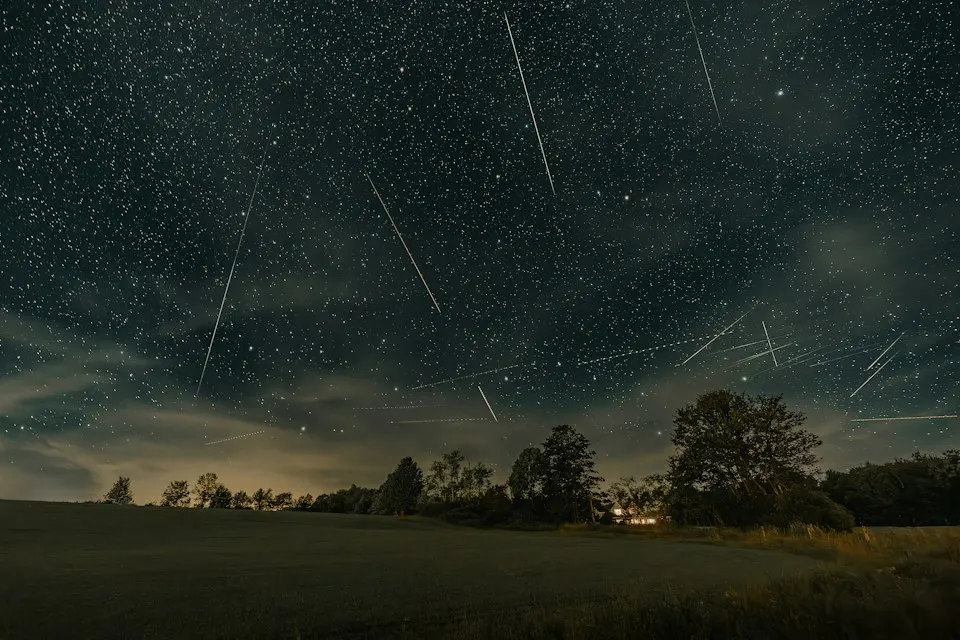
You cannot photograph a meteor on demand. You set the camera on a tripod, point it at a good part of the sky and shoot frame after frame for an hour or more. Out of several hundred frames, a few to a dozen will show a meteor. That is normal.
Why it is hard
A meteor usually shines for less than a second and crosses the sky in a random place. A camera with a wide lens covers only part of the sky and mostly records bright meteors. Faint ones that your eye still catches are often lost in the picture. So time matters: the longer the camera runs, the better the chance of a bright meteor or a fireball.
What to bring
- A camera with manual mode. Mirrorless or DSLR. Full frame gathers more light, but a smaller sensor also works.
- A wide, fast lens. Ideally 14–24 mm on full frame, at f/2.8 or faster. A wider field means more sky and more chances.
- A sturdy tripod. Nothing works without it.
- An intervalometer. Built into the camera or on a cable. It lets you shoot non-stop all night.
- Spare batteries and a large card. One night easily means several hundred RAW files.
- A lens heater. By water and in meadows the lens fogs up quickly. A heater strip powered from a power bank solves it.
Starting settings
- M mode, manual focus at infinity. In live view, zoom into a bright star and turn the ring until it is the smallest point. Tape the ring in place.
- Aperture wide open, or one stop down. For example f/2.8, or f/2 on an f/1.4 lens. A brief meteor flash needs as much light as possible.
- ISO 1600–3200. Go higher under a dark sky and lower near a town so the sky does not turn too bright.
- 10–25 second exposures. The 500 rule: divide 500 by the focal length to get the time after which stars start to trail. At 20 mm that is about 25 seconds. Longer exposures do not help with meteors, because the trail is short and the background just gets brighter.
- 1 second interval, or continuous mode. Gaps between frames must be as short as possible, because a meteor in a gap is lost.
- RAW, long-exposure noise reduction off. That feature takes a second, dark frame after every shot and doubles the dead time.
- White balance about 3800–4200 K. You can fix it later in RAW.
Where to point the camera
- 30–50° from the radiant. Meteors right next to the radiant are short. Those farther away have longer, more striking trails, yet you can still see that they come from one point.
- High, but not straight up. Roughly 45–60° above the horizon. Low down there is more haze and light glow.
- Away from the Moon and town lights. A bright background swallows faint meteors.
- With a foreground. A tree, a dune or a lighthouse at the bottom of the frame turns a meteor into a picture, not just a record.
When to shoot and how long to wait
The best chances come on the peak nights of the big showers: the Perseids in August and the Geminids in December. Even then the camera catches only part of what you see by eye, because it covers a smaller patch of sky and mostly records the brighter meteors. Set up as soon as it is fully dark and leave the camera running for several hours. Do not move the tripod, because every shift spoils stacking later. If the Moon is bright, wait until it sets or point the camera to the opposite side of the sky. Check the preview every fifteen minutes for focus drift and dew.
Phone
Phones take better night pictures every year, but night mode merges several frames and often smooths out or removes short flashes. A manual mode with 10–30 second exposures and ISO 800–1600 works better, on a tripod, with an app that shoots a series automatically. Use the main lens, because it is the brightest. Expect to record mostly bright meteors and fireballs.
Stacking
Popular pictures with dozens of Perseids are composites of many frames. You pick the frames with meteors, align them on the stars and lay them over one background. Astrophotography software does this semi-automatically. It is an honest technique, but label the picture as a composite, because no one ever sees that many meteors at once.
Common mistakes
- A plane or satellite instead of a meteor. A plane leaves a dashed line with blinking lights. A satellite draws an even line across the whole frame and shows up on the neighbouring frames too. A meteor usually starts and ends within one frame, tapers at the ends and can be coloured.
- Dew on the lens. Check every half hour.
- A flat battery in the middle of the peak. On a cold night, swap batteries before the camera tells you to.
Pick the date from the shower calendar and the spot from the meteor forecast. If you catch a bright fireball, report it to a fireball network. Your picture may help pin down where a meteorite landed.
Sources
- American Meteor Society: FAQ
- IMO Meteor Shower Calendar 2027 (PDF), contacts for the photographic and video commissions
- Polish Fireball Network (Wikipedia, in Polish)
- Comets and Meteors Workshop (PKiM)
Do not miss the next window
The best windows last a few hours: after a storm, after rain, on a clear night with an active Sun. Sign up and we will email you when the index at your spots goes above 60.