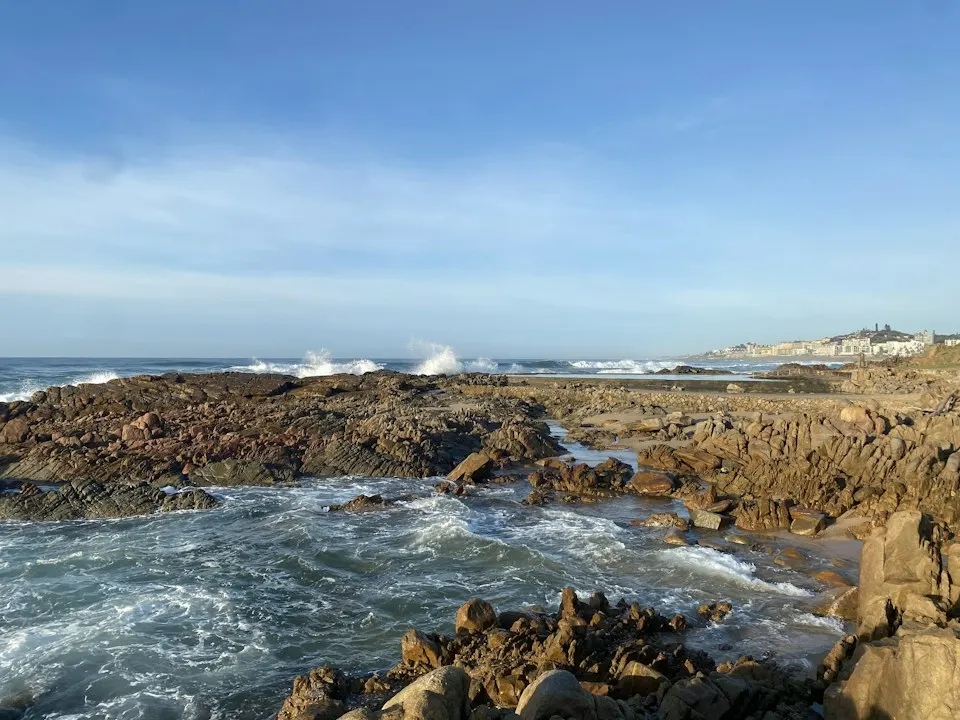
On the Baltic the tide is a few centimetres and nobody notices it. On the Atlantic, the English Channel and the North Sea, the water uncovers and floods hundreds of metres of shore every few hours. This guide explains how that works, when the low tide is lowest and how to get back in time.
Where tides come from
Tides are caused by the pull of the Moon and, to a lesser extent, the Sun. On most coasts of Western Europe the tide is semidiurnal: in a day and a bit under an hour there are two high waters and two low waters. So low water comes about 50 minutes later each day. If low tide is at 9:00 today, in a week it will be in the afternoon.
The size of the tide depends heavily on the place. In the Bay of Mont-Saint-Michel and on the Chausey islands the difference between high and low water reaches more than ten metres. In Lofoten it is much smaller, and in the Baltic there is practically none. That is why the spots in this module are only on tidal coasts.
Spring tides and neap tides
When the Sun, Earth and Moon line up, at new moon and full moon, their pulls add up. This gives spring tides: the highest high waters and the lowest low waters. They usually arrive a day or two after the new or full moon. The name has nothing to do with the season.
At the first and last quarter of the Moon the forces partly cancel out. These are neap tides: the range is smallest, and the lower shore does not uncover at all. The biggest tides of the year come around the equinoxes, in March and September.
In France the size of a tide is given as a coefficient (coefficient de marée) from 20 to 120. Above about 90 people talk of grandes marées. That is when the beaches of Brittany and Normandy fill with people carrying buckets.
How to read a tide table
A tide table gives the times of high and low water and the heights. In official tables, heights are measured from chart datum, which sits close to the lowest possible tide. So a low water of 0.5 m means a much bigger ebb than a low water of 2.0 m. Negative values also occur, meaning an exceptionally low tide.
Check which time zone the times are in. British tables often give GMT, so in summer you add an hour. Pick the port closest to your beach, because in the next bay low water can come tens of minutes earlier or later.
Official tide table sources:
- United Kingdom: UKHO, the Admiralty EasyTide service.
- France: SHOM, the maree.shom.fr service.
- Ireland: Marine Institute.
- Germany: BSH. Netherlands: Rijkswaterstaat. Denmark: DMI. Norway: Kartverket.
Our index takes the tide from the Open-Meteo model. The model gives sea level relative to mean sea level, not chart datum, so the numbers differ from the tables. Open-Meteo also notes that this data is not suitable for coastal navigation. Treat the forecast as a pointer and set your start time from an official table.
The rule of twelfths
The water does not fall evenly. The rule of twelfths is a simple way to estimate how much water drains in each hour of the roughly six hours between high and low water:
| Hour | Share of tidal range | With a 6 m range |
|---|---|---|
| 1st | 1/12 | 0.5 m |
| 2nd | 2/12 | 1.0 m |
| 3rd | 3/12 | 1.5 m |
| 4th | 3/12 | 1.5 m |
| 5th | 2/12 | 1.0 m |
| 6th | 1/12 | 0.5 m |
The lesson is practical. Right around low water the level changes slowly, so you have a quiet spell. Two or three hours later the water rises fastest. It is an approximation: in many places, such as bays and estuaries, the tide curve looks different.
Safety
The tide kills people who know the sea. In February 2004 the incoming tide cut off a group of cockle pickers in Morecambe Bay in England. At least 22 people died. In the Bay of Mont-Saint-Michel quicksand adds to a fast tide. You can only walk to the tidal island of Worm's Head in Wales for about 2.5 hours either side of low water, and rescuers bring people off it every year.
- Go out on a falling tide and start back at low water, not later.
- Before you go down, memorise your way back. Channels and hollows behind you flood first.
- On flat mudflats and in big bays, go with a licensed guide.
- Do not go out in fog. On a flat sea floor it is very easy to lose your bearings.
- Tell someone where you are going and carry a charged phone. The EU emergency number is 112; in the UK it is also 999 (ask for the Coastguard).
- A strong onshore wind and low pressure push the water above the forecast. The tide then comes in sooner and higher.
Once tides make sense, move on to the guide to rockpooling.
Sources
- Open-Meteo, Marine Weather API
- Rule of twelfths, Wikipedia
- Admiralty EasyTide (UKHO)
- SHOM, tide times
- Morecambe Bay cockling disaster, Wikipedia
- FFRandonnée, quicksand in the Bay of Mont-Saint-Michel
- Worm's Head, Wikipedia
Do not miss the next window
The best windows last a few hours: after a storm, after rain, on a clear night with an active Sun. Sign up and we will email you when the index at your spots goes above 60.