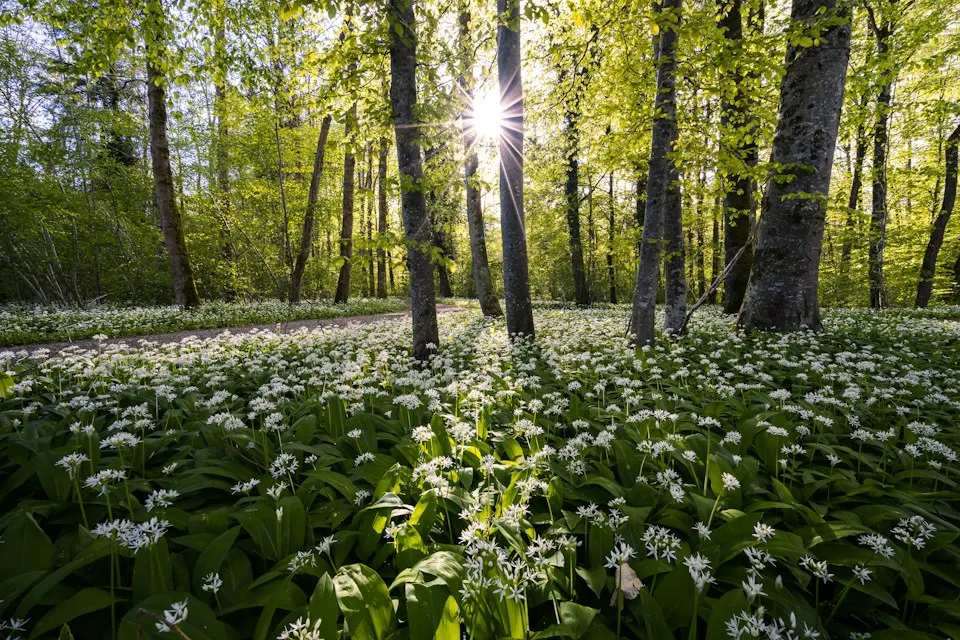
In much of Europe you may pick wild herbs for your own use in small amounts. The limits are similar everywhere: places where picking is banned, protected species, digging up roots and picking for sale. The details differ by country.
Poland: forests
Under the Polish Forest Act, wild herbs, fruit and mushrooms are forest produce (runo leśne). Article 27 opens state forests to picking them for personal needs. Picking for industrial purposes, meaning selling in larger amounts, needs an agreement with the forest district (nadleśnictwo).
You may not pick where entry is banned (art. 26): in forest plantations under 4 m tall, on research plots, in wildlife refuges and in areas closed for a time, for example because of fire risk. Article 30 also bans picking in places signed as closed, digging the ground and damaging plants. Owners of private forest can ban entry with a sign (art. 28).
Poland: national parks and reserves
Picking wild plants and fungi or their parts is banned in national parks and nature reserves (Nature Conservation Act, art. 15(1)(13)). The only exceptions are places designated by the park director or, in a reserve, by the regional environmental directorate (RDOŚ). In landscape parks, protected landscape areas and Natura 2000 sites, picking for your own use is usually allowed, but local bans may apply. Breaking the bans in a park or reserve is an offence punishable by detention or a fine (art. 127).
Poland: protected species
Protected plants are listed in the Environment Minister's regulation of 9 October 2014 (Journal of Laws 2014 item 1409). As of October 2026 no act has replaced it. For wild plants it bans, among other things, picking, collecting, keeping and selling. Breaking these bans is punishable by detention or a fine (Nature Conservation Act, art. 131(14)).
| Species | Status | What is allowed |
|---|---|---|
| Wild garlic | partial protection | Harvest only with a permit from RDOŚ or GDOŚ, by hand, from large populations in the Silesian, Lesser Poland and Subcarpathian voivodeships, leaving at least 75% of the population and the bulbs undamaged. Not allowed without a permit. |
| Sea buckthorn | partial protection | Fruit only, with a permit, without damaging the shrubs, and never on dunes or cliffs. |
| Dwarf everlast (Helichrysum arenarium) | partial protection | Flower heads only, with a permit, leaving at least 75% of the population. |
| Bogbean | partial protection | Cutting the herb only with a permit, once every 5 years at the same site. |
| Arnica | strict protection | No picking. |
| Thymus praecox | strict protection | No picking. The common wild thyme (Thymus serpyllum) is not protected. |
| Oxlip, autumn crocus, yew | partial protection | No picking. Autumn crocus and yew are poisonous. |
The bans apply to wild plants. You may pick and sell wild garlic or sea buckthorn from your own garden or a plantation. You may not move wild plants into your garden without a permit. Juniper, lily of the valley and sweet woodruff are not currently protected.
United Kingdom
In England and Wales you may pick leaves, flowers and fruit of wild plants, but uprooting any wild plant without the permission of the landowner or another authorised person is an offence (Wildlife and Countryside Act 1981, s. 13). Plants on Schedule 8 may not be picked at all. Picking for sale without consent can be theft (Theft Act 1968, s. 4(3)). In Scotland the Outdoor Access Code allows picking for personal use, while commercial picking needs the landowner's permission. SSSIs and nature reserves carry extra restrictions.
Germany
Section 39(3) of the Federal Nature Conservation Act (BNatSchG) lets anyone take wild flowers, grasses, fruit, mushrooms and herbs in small amounts for personal use, with care and only where entry is allowed. This is known as the handful rule (Handstraußregel). Picking for commercial purposes needs a permit from the nature conservation authority (§ 39(4)). Nature reserves (Naturschutzgebiet) and national parks usually ban picking.
France
Plants belong to the landowner. In state and municipal forests, picking for personal use is usually tolerated, while private land needs consent. The prefect can ban or limit picking of chosen species, such as arnica or yellow gentian (Code de l'environnement, art. L412-1 and R412-1). Breaking such an order can bring heavy penalties.
Czechia
The Czech Forest Act (Act 289/1995, § 19) lets anyone pick forest fruits for their own use without damaging the forest. Selling what you picked in someone else's forest is not covered by this right. In national parks and reserves, nature conservation rules limit picking, and protected species are excluded.
Scandinavia
In Sweden, allemansrätten lets you pick wild flowers, herbs and fruit that are not protected, on private land too, but without digging plants up and not near homes. Finland's everyman's rights (jokamiehenoikeudet) and Norway's allemannsretten work in a similar way. Nature reserves may ban picking, and regional authorities keep the lists of protected species.
United States
In national forests each forest sets its own rules. At Mount Hood in Oregon, for example, you may pick up to 3 gallons of berries a year without a permit, and you may not sell them. In North Carolina's national forests you may take up to 3 pounds of ramps for personal use. Picking for sale always needs a paid permit. In national parks you may only gather what the individual park's rules allow.
Sources
- Polish Regulation on plant species protection (Journal of Laws 2014 item 1409)
- Polish Nature Conservation Act, consolidated text 2026 item 1315
- Polish Forest Act, consolidated text 2026 item 663
- Wildlife and Countryside Act 1981, s. 13
- Theft Act 1968, s. 4
- Scottish Outdoor Access Code: collecting wild food
- § 39 BNatSchG
- Naturvårdsverket: picking flowers, berries and mushrooms
- Luontoon.fi: everyman's rights
- USDA Forest Service, Mt. Hood: special forest products
Do not miss the next window
The best windows last a few hours: after a storm, after rain, on a clear night with an active Sun. Sign up and we will email you when the index at your spots goes above 60.