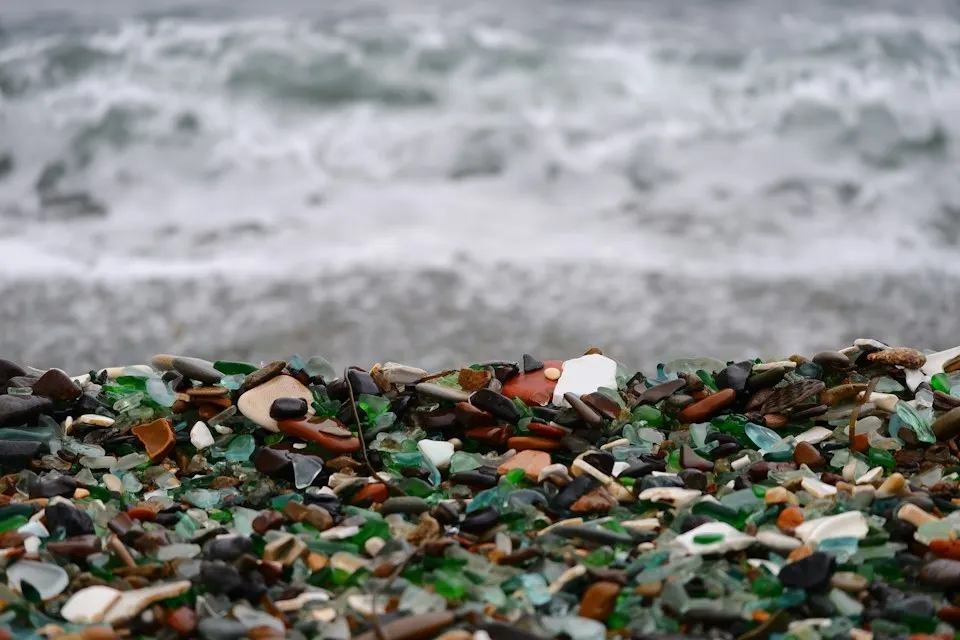
Sea glass is a piece of an ordinary bottle, jar or plate that has tumbled in the sea for decades. Waves and sand have rounded its edges and the water has frosted its surface. It is litter that has turned into a small treasure.
How sea glass forms
Broken glass reaches the sea in many ways: from old shoreline dumps, from glass works and factories, from ships that threw bottles overboard, and from wrecks. The waves then roll it over sand and stones. Sharp edges slowly wear away and the piece becomes smooth and rounded.
Collectors’ references say the process usually takes 20–40 years, and sometimes 100–200 years. The frosted surface comes from the water slowly leaching components out of the glass. Genuine pieces often show tiny C-shaped marks. These are impact marks from stones and one of the surest signs that a piece has spent a long time in the sea.
Glass from lakes and rivers is called beach glass. It is usually less frosted, because fresh water acts more gently than salt water.
Colours and how rare they are
The colour depends on what the glass used to be. Most of it comes from ordinary beer, soft drink and wine bottles, so green, brown and white are what you find most. Collectors sort colours into a few groups. The ratios below are approximations from collectors’ tallies, not exact measurements.
- Common: bottle green, brown, white (clear glass). The backbone of every collection.
- Less common (about 1 in 25–100): jade, amber, lime and forest green, soft blue. They come from whisky, medicine and old laundry bottles.
- Rare (about 1 in 200–1,000): purple, citron, opaque milk-glass white, cobalt, cornflower blue and aqua from jars.
- Very rare (about 1 in 1,000–10,000): grey, pink, teal, black, yellow, turquoise, red and orange. Red turns up roughly once in 5,000 pieces, orange once in 10,000.
Orange glass comes mainly from tableware made in the early 20th century by a handful of firms. Red was never mass-produced, because the colourant was expensive. Some “black” sea glass is really very dark green or brown from 18th and 19th-century bottles. Hold it up to the light to see its true colour.
Purple pieces were often clear to begin with. Glassmakers once added manganese, which slowly turns the glass a light purple in sunlight.
Sea glass on the Baltic
In Poland sea glass is still little known. Jewellery makers in the Tricity collect it mainly at Sopot and on other beaches of the Gulf of Gdańsk. Shades of green, brown, white and blue are the most common. For rare colours they travel to beaches in western Europe.
Two things make the Baltic harder. It has almost no tides, so the sea does not uncover a wide strip of shore twice a day. And most beaches are sandy, while glass likes to settle among stones. That is why it pays to search by breakwaters and groynes and on stretches with fine gravel, close to old ports.
The best-known spots in the world
- Seaham in England: from 1853 to 1921 the Londonderry Bottleworks, the largest glass bottle works in Britain, operated here. Its waste glass was dumped at sea and returns with every tide.
- Glass Beach in Fort Bragg, California: a former dump, now part of a state park, where the glass is for looking at only.
- Davenport, California: art glass from a studio, carried into the sea by a flood.
- Praia dos Cristais in Spain: a cove full of sea glass from an old bottle dump.
What next
To find out when to go to the beach, read when to look for sea glass. Where collecting is banned is covered in rules and bans, and prices and fakes in value and selling.
Sources
- Wikipedia: Sea glass
- Tygodnik Powszechny: the most valuable “mermaid’s tears” (Polish)
- Sopot Sea Glass: FAQ (Polish)
- Prestiż Trójmiasto: jewellery from the seabed (Polish)
- Wikipedia: Seaham
- International Sea Glass Association: Genuine vs. Artificial
Do not miss the next window
The best windows last a few hours: after a storm, after rain, on a clear night with an active Sun. Sign up and we will email you when the index at your spots goes above 60.