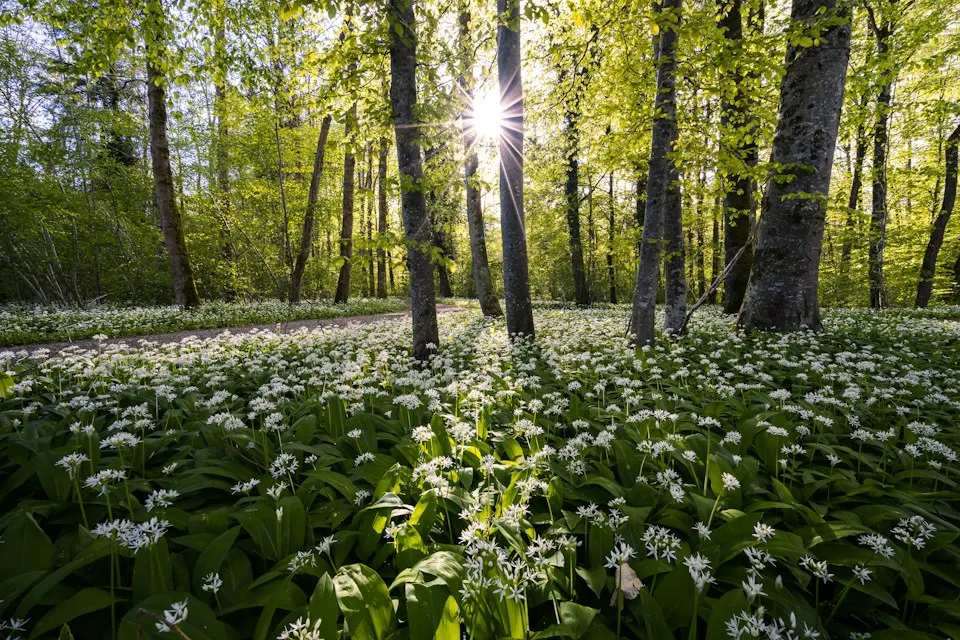
Selling wild herbs is legal in Poland, but only for unprotected species and only within food law. The simplest route is to take your harvest to a herb buyer (skup ziół). Selling straight to customers means running a food business. One hard rule applies to every route: you must not claim that a herb helps with anything.
What Polish herb buyers pay
Buyers pay for fresh (wet) material or for dried, cleaned material. Example prices from two 2026 price lists, in Polish złoty per kilo (1 PLN is roughly 0.23 EUR):
| Material | Fresh (PLN/kg) | Dried (PLN/kg) | Buyer, date |
|---|---|---|---|
| Lime blossom | 18.00 | n/a | Zioła Siedleckie, August 2026 |
| Nettle leaf | 2.00 | n/a | Zioła Siedleckie, August 2026 |
| Dandelion leaf | 1.50 | n/a | Zioła Siedleckie, August 2026 |
| Rosehip | 6.00 | n/a | Zioła Siedleckie, August 2026 |
| Meadowsweet flower | 3.50 | n/a | Zioła Siedleckie, August 2026 |
| Yarrow herb | 4.00 | 15.00 | Zioła Siedleckie / Dary Natury |
| Wild strawberry leaf | 10.00 | 25.00 | Dary Natury, 19.10.2026 |
| Dandelion root (conventional) | 4.00 | 22.00 | Dary Natury, 19.10.2026 |
| Dandelion root (organic) | 6.00 | 30.00 | Dary Natury, 19.10.2026 |
Several kilos of fresh leaves dry down to about 1 kg, which is why dried material pays several times more. Buyers accept only species on their current list and set their own standards for cleanliness and moisture. Call before you pick. Roots may only be dug with the landowner's consent, not in a state forest.
What you may not sell
- Wild protected species, such as wild garlic or sea buckthorn, without a permit from RDOŚ or GDOŚ. The regulation bans selling, offering for sale and keeping them. Wild garlic you grew yourself can be sold.
- Plants from national parks and reserves, where picking is banned.
- Larger amounts from a state forest without an agreement with the forest district. The Forest Act (art. 27) requires one for picking for industrial purposes.
- Anything you cannot identify for certain, and plants from polluted places.
Food safety registration
Herbs meant to be eaten or drunk as an infusion are food. Polish sanitary inspectors treat picking forest produce and taking it to a processing plant as primary production. Anyone producing or placing food on the market must apply to the district sanitary inspector to be entered in the register of establishments (Food Safety Act, art. 61 and 62). Registration is free. Operating without it can bring a fine of 1,000 to 5,000 PLN (art. 103). The rules do not say clearly whether someone who occasionally takes their own harvest to a buyer needs to register. Ask your district sanitary station (PSSE).
Selling packets of dried herbs to customers, online or at a market, means following food labelling rules. The label must show, among other things, the name, quantity, best-before date and the producer's details. Selling herbs as a food supplement requires a separate notification to the Chief Sanitary Inspector.
The ban on health claims
EU law forbids attributing to any food the property of preventing, treating or curing a human disease (Regulation 1169/2011, art. 7(3)). Regulation 1924/2006 allows health claims only when they are authorised and listed in the EU register. Claims for plants (botanicals) sit in the register marked "on hold". There are around 2,000 of them, and the European Commission has not finished assessing them in more than a decade. They are not authorised, and their use under the transitional rules is legally disputed. The safest course is not to use them.
If you present a product as having properties for preventing or treating disease, Polish Pharmaceutical Law (art. 2(32)) treats it as a medicinal product. Such a product needs a marketing authorisation, and advertising medicinal products is strictly regulated (art. 52 onwards). Traditional herbal medicinal products have a simplified registration under Directive 2004/24/EC (art. 20a of the Pharmaceutical Law). It requires, among other things, evidence of at least 30 years of use, including 15 years in the EU, and it is not open to someone selling dried herbs from a meadow.
In practice: say what the plant is, where it comes from, when it was picked and how to use it in the kitchen. Do not say what it helps with, supports, treats or soothes.
Tax in Poland
Income from selling herbal raw materials and wild forest herbs, berries, forest fruit and forest mushrooms that you picked yourself or with close family is exempt from income tax (PIT Act, art. 21(1)(72)). The exemption covers raw material from your own picking, not processed products or herbs bought from other people. If you sell regularly, ask the tax office whether you need to register a business.
Novel food
The plants in our calendar have long been eaten in Europe. Novel food is food not consumed to a significant degree in the EU before 15 May 1997, and it needs EU authorisation. Check the European Commission's catalogue if you want to sell an unusual plant part or an extract.
Sources
- Dary Natury: herb buying list, 19.10.2026 (Polish)
- Zioła Siedleckie: buying prices, August 2026 (Polish)
- Polish Food Safety Act, consolidated text 2026 item 1399
- Polish PIT Act, consolidated text 2026 item 592, art. 21(1)(72)
- Regulation (EC) No 1924/2006 on nutrition and health claims
- European Commission: EU register of health claims
- Directive 2004/24/EC on traditional herbal medicinal products
- Vitafoods Insights: on-hold botanical claims (2024)
- European Commission: Novel Food status catalogue
Do not miss the next window
The best windows last a few hours: after a storm, after rain, on a clear night with an active Sun. Sign up and we will email you when the index at your spots goes above 60.