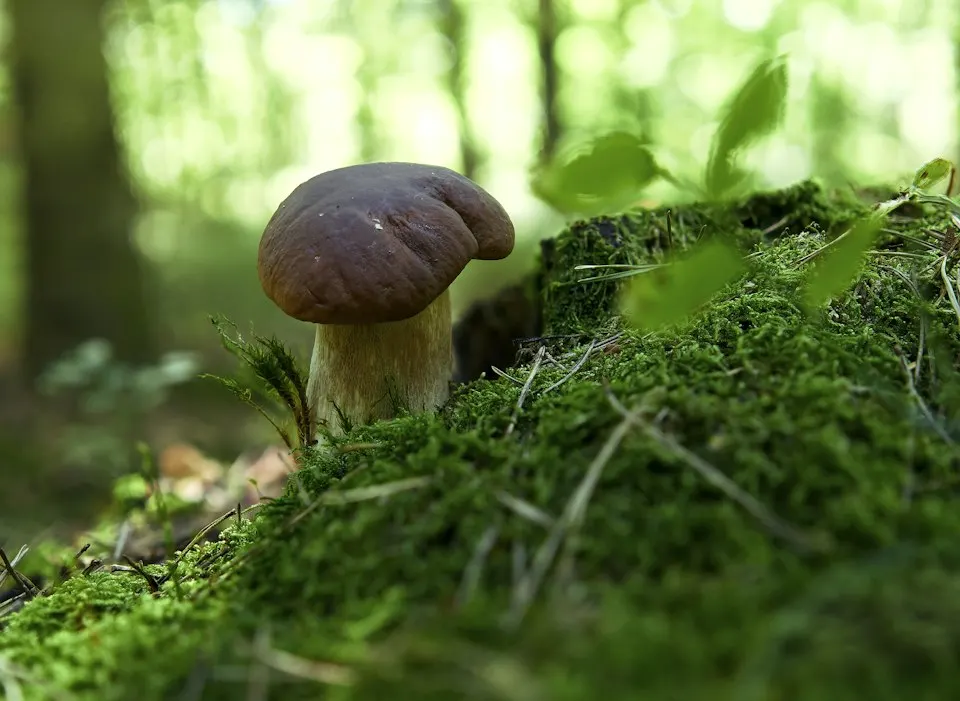
Selling forest mushrooms in Poland pays for petrol and small extras. It is not a living. The simplest and safest route is a buying point (punkt skupu). A market pays more but needs a certificate (atest). Selling to consumers at the roadside or through online ads is not allowed.
Please note: this is general information based on the law as of 30 October 2026, not legal or tax advice. Rules and prices change. Check the acts in ISAP, ask the local sanitary station (sanepid) and the forest district (nadleśnictwo), and for tax questions call the National Tax Information service (KIS): +48 22 330 03 30.
What buying points and markets pay
There is no single national price. Buying points cut prices when there are lots of mushrooms, and they sort them into grades. Below are prices from named places and dates in the 2026 season.
| Species | Buying point (Lubuskie, 13 Sep 2026) | Market (Małopolska, 20 Sep 2026) |
|---|---|---|
| Porcini (prawdziwek, borowik) | about 15 zł/kg grade I, 7 zł grade II, 5 zł grade III | 60 to 90 zł/kg |
| Chanterelle (kurka) | 20 zł/kg (30 zł two weeks earlier) | about 60 zł/kg |
| Bay bolete (podgrzybek) | 8 zł/kg; the buyer warned it may pay only 3 zł at the peak of a flush | 50 to 70 zł/kg |
Grade I means young, firm, white porcini. In July 2026, pickers offered chanterelles at about 30 zł/kg in Silesia and up to 55 zł/kg in Pomerania. On OLX, chanterelle prices fell to 20 to 35 zł/kg in August. Shops charged over 100 zł/kg. A market pays more because it means a certificate, a market fee and hours behind a stall.
What a day realistically earns
There is no reliable statistic for daily earnings. Here is an example using September 2026 buying-point prices from Lubuskie. It is arithmetic, not an average.
- Good day: 10 kg of bay boletes at 8 zł, 2 kg of chanterelles at 20 zł and 2 kg of grade I porcini at 15 zł. That is 150 zł before fuel.
- Peak of a flush: the same 10 kg of bay boletes at 3 zł brings 30 zł.
- Poor day: a few mushrooms for your own dinner, and the cost of the drive.
Add several hours of walking, cleaning and delivering to the buyer the same day. Mushrooms lose quality fast, and wormy ones fetch less or get turned away. To pick a good day, check the mushroom forecast.
Where and how to sell legally
Buying point (punkt skupu)
This is the simplest route. The Food and Nutrition Safety Act does not apply to people who individually pick wild mushrooms from the official list (art. 2(2)). The duties sit with the buyer: it must employ a mushroom classifier or mushroom expert (art. 71) and hold a certificate for the mushrooms it buys (§ 3(1) of the regulation). You bring clean mushrooms sorted by species, and the buyer checks, weighs and pays.
Market (targowisko)
Fresh wild mushrooms may be offered to consumers only in shops or at markets, and only with a certificate (§ 4(1) of the regulation). At a market you also pay the local market fee (opłata targowa) set by the municipality. A certificate covers only the batch that was checked, so do not add mushrooms nobody has looked at.
Roadside
Selling mushrooms to consumers at the roadside is against the law, even with a certificate, because a lay-by is neither a market nor a shop. Sanitary stations say selling in a non-permitted place or without a certificate can mean a fine of 500 to 5000 zł. On municipal land, art. 60[3] of the Code of Petty Offences (selling outside places set by the municipality) also applies, with a fine of up to 5000 zł and forfeiture of the goods. Occupying the road strip without the road authority's permit carries a penalty of ten times the fee (art. 40(1) and (12) of the Public Roads Act).
Online
Ads on OLX or in social media groups, with pickup from home or delivery, are neither a shop nor a market under § 4(1). For a private person this is not a legal way to sell fresh or dried wild mushrooms. Selling food as a business requires registering with sanepid and meeting the rules for food establishments.
The certificate (atest): who issues it and what is checked
A certificate for fresh mushrooms (atest na grzyby świeże) is issued by a mushroom classifier (klasyfikator grzybów) or a mushroom expert (grzyboznawca). A certificate for dried mushrooms is issued only by a mushroom expert. Not every sanepid station issues certificates itself. Some offer only a free check of mushrooms for your own table. Call the local station and ask who issues certificates nearby and what it costs.
Fresh mushrooms must meet art. 42(1) of the Food and Nutrition Safety Act:
- one species per batch, with no mould,
- whole fruit bodies, cut at most once along the stem,
- no live larvae, and wormy mushrooms no more than 5% of the weight,
- organic debris such as needles or moss no more than 0.3%, and mineral debris no more than 1%.
Since 4 December 2024 the certificate template no longer includes the limit of 48 hours of storage at up to 10°C. Dried mushrooms for consumers must be in single packs labelled with the species, the certificate number and the year of harvest.
Only species listed in Annex 1 to the regulation may be sold. Porcini, chanterelle and bay bolete are on the list. Some listed species may be sold only if cultivated, and morels only from gardens, nurseries and green areas. Protected species must not be picked at all. For safe identification, see how to avoid mushroom poisoning.
Picking for your own needs versus commercial picking
The Forests Act opens state forests for picking forest produce (runo leśne) for your own needs and for industrial purposes. Picking for industrial purposes requires a contract with the forest district, which must refuse it if picking threatens the forest (art. 27). The Act does not define these terms. In practice, people pick by hand and sell part of their haul to buying points without a contract. If you organise picking on a larger scale, for example with hired pickers for a company, ask the forest district before you start.
Where picking is not allowed:
- young plantations under 4 m, experimental plots, seed stands, wildlife refuges, spring areas and erosion zones (art. 26(2) of the Forests Act),
- forests under a temporary entry ban, for example at high fire risk (art. 26(3)),
- marked no-picking areas (art. 30(1)(7)) and private forests with a no-entry sign (art. 28),
- national parks and nature reserves, except places designated by the park director or the regional environment directorate (art. 15(1)(13) of the Nature Conservation Act).
Picking in a forbidden place or in a forbidden way can bring a fine of up to 250 zł or a reprimand (art. 153 § 1(4) of the Code of Petty Offences). Deliberately breaking the rules in a national park or reserve falls under art. 127 of the Nature Conservation Act. More detail: where you can pick mushrooms in Poland.
Taxes
The exemption is real. Art. 21(1)(72) of the Personal Income Tax Act exempts income from selling forest mushrooms, berries, forest fruit and wild herbs, provided you pick them yourself or with close family members. If you picked the mushrooms yourself and sold them to a buying point or, with a certificate, at a market, you generally owe no PIT on it.
The exemption does not cover:
- mushrooms bought from others and resold. Organised, regular buying and reselling may be treated by the tax office as a business,
- picking by friends or neighbours who are not close family.
It is not clear whether the exemption covers mushrooms you process yourself, for example pickled or dried. Ask KIS before selling preserves. Preserves are a separate matter anyway, because making them for sale requires registration with sanepid.
Where income is not exempt and the selling counts as a business, from 2026 unregistered activity (działalność nierejestrowana) covers revenue of up to 225% of the minimum wage in each quarter, which is 10,813.50 zł (art. 5(1) of the Entrepreneurs' Law). That revenue is still declared for PIT.
Agricultural retail trade (rolniczy handel detaliczny) does not help here. It covers food in which at least one ingredient comes from your own crops or livestock (art. 3(3)(29b) of the Food and Nutrition Safety Act). Forest mushrooms are not a crop.
In short
- Simplest: a buying point. No certificate needed on your side, no PIT on your own harvest.
- More money: a market, but only with a certificate and after the market fee.
- No: roadside, OLX, selling from home.
- Pick only where it is allowed, and only species on the official list.
Sources
- Minister of Health regulation on mushrooms permitted for sale, consolidated text, Dz.U. 2026 item 258 (checked 30 Oct 2026)
- Regulation of 14 Nov 2024 changing the certificate template, Dz.U. 2024 item 1686 (checked 30 Oct 2026)
- Food and Nutrition Safety Act, Dz.U. 2026 item 1399 (checked 30 Oct 2026)
- Forests Act, Dz.U. 2026 item 663 (checked 30 Oct 2026)
- Nature Conservation Act, Dz.U. 2026 item 1315 (checked 30 Oct 2026)
- Regulation on protected fungi species, Dz.U. 2014 item 1408 (checked 30 Oct 2026)
- Code of Petty Offences, Dz.U. 2026 item 1372 (checked 30 Oct 2026)
- Public Roads Act, Dz.U. 2025 item 889 (checked 30 Oct 2026)
- Personal Income Tax Act, Dz.U. 2026 item 592 (checked 30 Oct 2026)
- Entrepreneurs' Law, Dz.U. 2025 item 1480 (checked 30 Oct 2026)
- Money.pl: unregistered activity limit 2026, 10,813.50 zł (in Polish) (checked 30 Oct 2026)
- Sanitary station Parczew: mushroom trade, 13 Aug 2025 (in Polish) (checked 30 Oct 2026)
- Bezprawnik: roadside mushroom sellers, 14 Oct 2026 (in Polish) (checked 30 Oct 2026)
- Wieści Rolnicze: buying-point prices, 13 Sep 2026 (in Polish) (checked 30 Oct 2026)
- RMF24: market prices, 20 Sep 2026 (in Polish) (checked 30 Oct 2026)
- Polsat News: chanterelle prices, 23 Jul 2026 (in Polish) (checked 30 Oct 2026)
- Interia Biznes: chanterelle prices on OLX, August 2026 (in Polish) (checked 30 Oct 2026)
- Radio Kraków: market mushrooms without a certificate, 20 Oct 2022 (in Polish) (checked 30 Oct 2026)
- Rzeczpospolita: when mushroom trading becomes a business (in Polish) (checked 30 Oct 2026)
Do not miss the next window
The best windows last a few hours: after a storm, after rain, on a clear night with an active Sun. Sign up and we will email you when the index at your spots goes above 60.